Keyword Difficulty in 2026: What It Measures and Whether to Trust It
Short answer: trust keyword difficulty as a rough comparison tool, not as a verdict. The score is a third-party guess at how crowded a search result looks, built mostly from the backlinks of the pages already ranking. It is genuinely useful for sorting one list of keywords from easiest to hardest. It is close to useless for deciding whether your page, on your site, can actually rank.
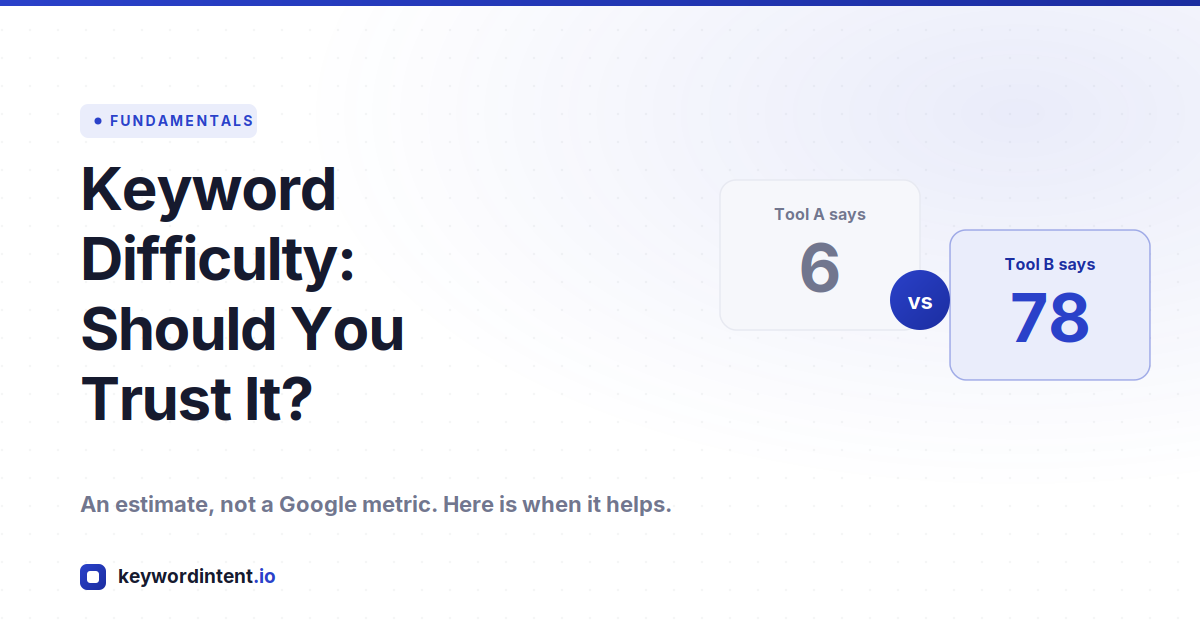
The confusion starts the moment you notice the same keyword reads 6 out of 100 in one tool and 78 in another. Both numbers are real, and both are estimates of different things. Once you understand what the score is built from and what it leaves out, you stop treating it as the answer and start using it for the one job it does well.
Keyword Difficulty Is Not a Google Number
Google does not publish a difficulty score and does not use one. Every number you see in Ahrefs, Semrush, Moz, or Ubersuggest is invented by that tool to approximate something Google never reveals: how hard it would be to break into the top results for a term.
That single fact explains most of the frustration around the metric. You are not reading a measurement. You are reading one company's model of a competition you cannot see directly. A model can be helpful, but it is only as good as the inputs it can reach, and no tool can reach the full ranking system.
Why One Tool Says 6 and Another Says 78
If a keyword shows a low score in one tool and a high score in another, neither is broken. They are measuring with different crawlers, different link indexes, and different formulas, then refreshing on different schedules. A score is only meaningful next to other scores from the same tool.
The same keyword, two tools
Chasing the "accurate" tool is the wrong question. The score has no objective truth to match against, because the thing it estimates lives inside Google. Consistency within one tool is worth far more than agreement between two.
What the Score Is Actually Built From
Most difficulty scores start in the same place: the tool looks at the pages currently ranking on page one and asks how strong their backlink profiles are. The more links those pages have, and the more authoritative those links look, the higher the difficulty.
From there the tools diverge. Some lean almost entirely on link counts and link quality. Others fold in domain and page authority estimates, or signals from the result page itself. The exact recipe is proprietary and varies, but the backbone is nearly always the same: this is a link-weighted reading of who is already there.
That tells you the metric is fundamentally backward looking. It describes the incumbents. It does not describe the query, the searcher, or whether the existing pages are any good.
The Average Hides the Opening
Here is the trap that costs people real keywords. A difficulty score is usually a blend, often an average, across all the top results. One high number can be dragged up by a couple of heavyweight domains while a weak, beatable page sits quietly at position seven.
The score smooths that page out of view. You see an intimidating number, assume the whole SERP is locked down, and walk away from a result you could have cracked by displacing the single weakest competitor. The average tells you about the room on average. It does not tell you about the door that was left open.
This is why a number alone should never end the decision. The opportunity in any SERP is the weakest page you can outrank, not the strongest one you cannot.
It Knows the SERP, Not Your Site
Difficulty is treated as a property of the keyword, but ranking is a contest between specific sites. The score has no idea who you are. It does not know your domain's authority, your existing rankings in the topic, or how much the subject already trusts you.
So the same term is genuinely easy for one site and genuinely hard for another, and the number cannot reflect that. A site with real topical authority in an area routinely ranks for terms its difficulty score calls hard, because relevance and trust the tool cannot see are doing the work.
What practitioners keep saying
- Scores are not comparable across tools. They are only relative inside the one tool that produced them.
- The number is mostly a read on the backlinks of the top pages, and an average can scare you off a winnable keyword.
- What is hard for one site is easy for another. Difficulty ignores your authority and your relevance entirely.
- People rank for high-difficulty terms with little link building all the time, when intent and topical fit line up.
- The reliable move is to open the actual SERP and check the allintitle count, not to trust a single score.
Intent Is the Variable It Cannot See
A difficulty score counts strength. It does not read why someone is searching, and intent is often the thing that decides the result. Two keywords can carry identical scores while one is a casual browse and the other is a person ready to act.
Google has gotten sharp at matching intent, which means a page that answers the precise question can climb past stronger pages that answer a slightly different one. That is also why operators report ranking inside the top ten for terms in the seventy and eighty range with barely any link building. They did not beat the difficulty. They matched the intent more cleanly than the incumbents.
The lesson is to lead with intent and treat difficulty as a secondary filter. Find what the searcher actually wants first, using the SERP and tools like the Reddit Topic Hunter for the real questions people ask, then let the difficulty score sort what is left.
Read the SERP, Not the Score
The number gets you to a shortlist. The search results page settles the question. Before you commit to any keyword, open the results and look at what is actually there.
Three things decide it:
- Are the top results thin or outdated? Old posts, shallow pages, and off-target answers are the openings a difficulty score papers over.
- Is there a weak link in the page-one set? You do not need to beat the strongest result, only the weakest one you can displace.
- Can you answer the intent better? If your page can resolve the query more completely than anything ranking, the score stops mattering.
A SERP full of strong, current, genuinely helpful pages is hard even when the score looks low. A SERP of dated forum threads and one thin listicle is winnable even when the score looks high. The page in front of you is more honest than the number describing it.
The allintitle Cross-Check
A practical second opinion costs nothing. Searching allintitle:your keyword returns only the pages that put the exact phrase in their title, which is a fast proxy for how many sites are deliberately targeting the term rather than mentioning it in passing.
A low allintitle count next to real search demand is one of the cleaner signals that a term is gettable, regardless of what a difficulty score says. Pulling those counts by hand at scale is the tedious part, which is exactly what the KGR Tool automates, scoring a batch of keywords so you can compare real targeting pressure instead of a black-box number. If you want the full method behind it, the KGR guide walks through how to read the result.
Where Difficulty Sits in the AI Search Era
AI answers from ChatGPT, Perplexity, and Google's own summaries have shifted what gets surfaced. These systems pull from pages that explain a topic clearly and credibly, and those pages are not always the top three classic results. That does not retire keyword difficulty. It demotes it.
Most search traffic still comes from ordinary Google results, so the incumbents a difficulty score measures still matter. But the score has become a friction indicator rather than a decision maker. It tells you how crowded a space looks. It says nothing about whether you will be the clear, citable answer, which is increasingly what wins both a ranking and a mention in an AI response.
The factors that help with AI visibility, clear answers, topical authority, and credible sourcing, are the same factors that have made classic SEO work for years. Difficulty is now table stakes: useful to glance at, never the thing you optimize for.
How to Actually Use Keyword Difficulty
Used in the right slot, the score saves time. Used as a verdict, it throws away good keywords. This is the order that keeps it in its lane.
- Start from intent, not the score. Build a seed list around what your buyer is actually trying to do, using the SERP and real questions people ask.
- Pull difficulty from one tool only, and read it as a relative ranking of your own list, never as an absolute or a cross-tool comparison.
- Sort the list by score to decide rough order of attack, putting the lower-friction terms first while your site is still building trust.
- Cross-check survivors with an allintitle count to see real targeting pressure rather than a modeled number.
- Open the SERP for each candidate. Confirm the top results are beatable and that you can answer the intent better.
- Group the winners into a tight cluster with the Keyword Grouping Tool so the topic reinforces itself instead of fighting alone.
When to Trust It, When to Ignore It
| Situation | How much to trust the score |
|---|---|
| Sorting one keyword list by difficulty | Trust it. This is the one job it does well. |
| Comparing scores across two tools | Ignore it. They are not on the same scale. |
| Judging how crowded a space looks | Useful as a rough friction read. |
| Deciding whether your page will rank | Not enough. Read the SERP and check intent. |
| High score where you have topical authority | Often beatable. The score does not know your site. |
| Low score on a SERP of strong, current pages | Do not trust it. Low number, hard fight. |
Frequently Asked Questions
Which tool has the most accurate keyword difficulty?
None of them is accurate in an absolute sense, because Google does not publish the thing they are estimating. The useful move is to pick one tool and use its scores only against each other. Switching tools to find a friendlier number tells you nothing real.
Why does the same keyword show 6 in one tool and 78 in another?
Each tool uses a different crawler, a different link index, and a different formula, then updates on its own schedule. The scores are estimates of slightly different things, so they will rarely line up. Compare within a tool, never between tools.
Should I avoid high difficulty keywords?
Not automatically. A high score is often an average dragged up by a couple of strong pages while a weak, beatable result sits lower on page one. If you have relevance in the topic and can answer the intent better, high-difficulty terms are frequently within reach.
Does keyword difficulty still matter in 2026?
Yes, but as a friction indicator rather than a decision maker. Most traffic still comes from classic Google results, so the incumbents it measures still count. Intent, clear answers, and topical authority decide the outcome, and difficulty is now table stakes you glance at, not the thing you optimize for.
What should I check instead of the difficulty score?
Open the SERP. Look at whether the top results are thin or outdated, whether there is a weak page you can displace, and whether you can serve the intent more completely. Back it with an allintitle count to gauge real targeting pressure.
Can a new site rank for difficult keywords without backlinks?
Sometimes, when the term has weak incumbents and you match intent precisely, especially across a tight cluster that builds topical relevance. Links still help, but a low difficulty score is not a prerequisite and a high one is not a wall.
Keyword difficulty is a useful filter wearing the costume of an answer. Use it to sort one list from easiest to hardest, read it only against itself, and let it point you toward shortlists. Then decide with the things it cannot see: the SERP in front of you, the intent behind the query, and your own site's relevance. Start by finding intent-led terms on the keyword tool, sanity-check targeting pressure in the KGR Tool, and let the score be the assistant, not the decision.