What Is Keyword Intent? Free Keyword Research Tool With Exact Search Volume Data
Deciding whether a keyword deserves a 3,000-word article is impossible when Google Keyword Planner answers with a range like “1K–10K.” That spread is too wide to make the call.
Keyword Intent pulls exact monthly search volume straight from the Google Ads API, the same source Planner uses, and shows it free, with no signup and no daily cap. A precise number is direction; a range is only a guess.
What Is Keyword Intent?
Keyword intent, also called search intent, is the purpose behind a search query. It explains why someone typed those words, not just what they typed.
Intent is rarely clean. “Best keyword research tool” looks commercial, since the searcher is weighing options, yet it carries an informational layer because they are still learning what separates one tool from another.
Matching that intent means matching the angle, not only the page type. A product page loses here; a comparison guide written from real use wins.
Informational queries now trigger Google AI Overviews 39.4% of the time. Content that answers them has to be structured so AI can lift a clean answer and cite it, not bury the point three paragraphs deep.
This is why Keyword Intent puts search volume, CPC, and competition on one screen. Intent without volume is blind, and volume without intent context is a guess.
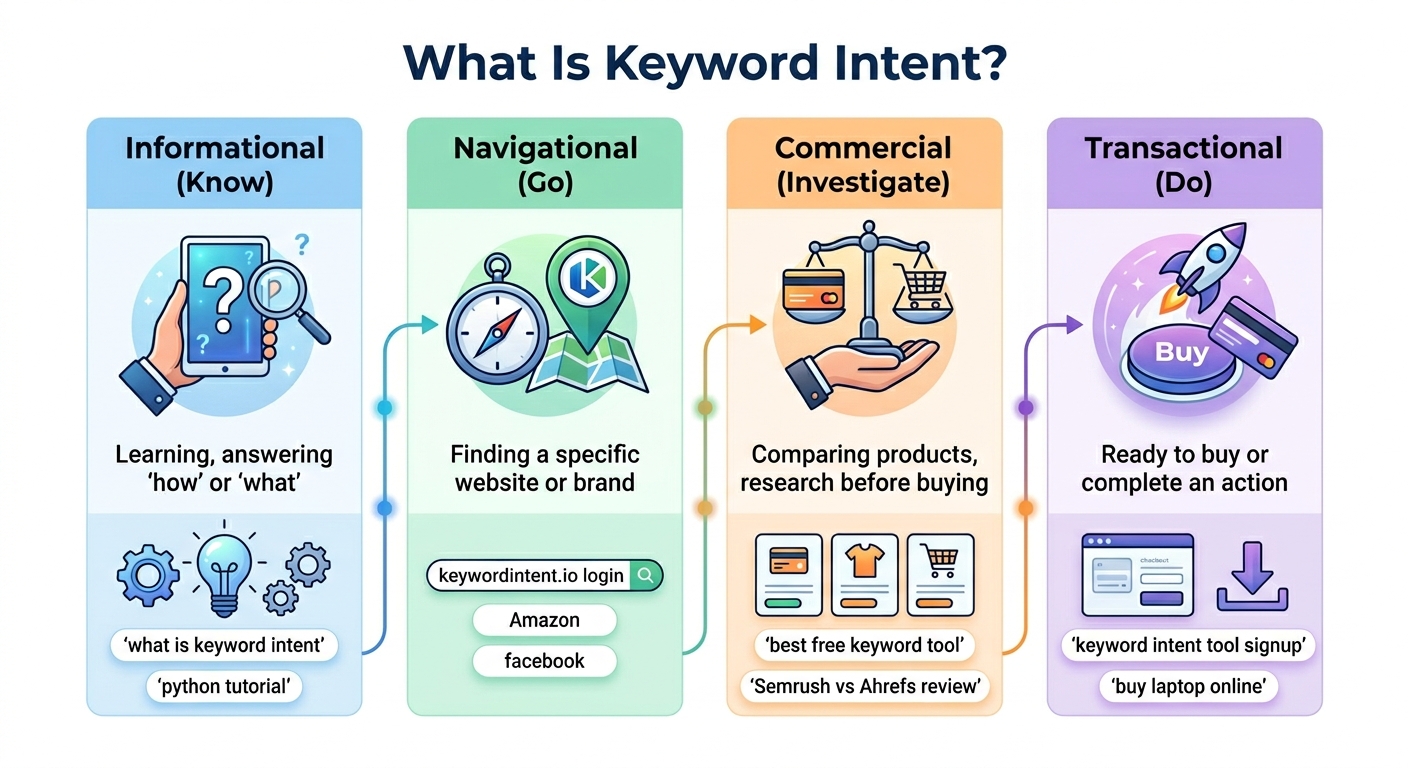
The 4 Types of Keyword Intent: What Each One Means for Your Content
Each type points to a different page and a different number that matters most. Skip the generic definitions; here is what each one changes about the decision.
| Intent type | Example query | Content to build | Metric that matters |
|---|---|---|---|
| Informational | “what is keyword difficulty” | Blog post, guide, FAQ | Search volume + trend direction |
| Navigational | “keywordintent.io” | Brand or tool page | CTR (volume is irrelevant here) |
| Commercial | “best free keyword research tool” | Comparison, review | CPC (high CPC means buyer intent nearby) |
| Transactional | “free keyword tool no signup” | Tool landing page | Volume + low competition |
CPC is the most underused number in keyword research. An advertiser paying $8 a click is telling you that keyword converts, and that single figure reads buyer intent faster than any category label.
Keyword Intent shows CPC beside search volume on every result, so the signal sits in front of you before you commit a word.
How to Check Keyword Search Volume for Free
Every keyword decision comes down to exactly three numbers.
Volume shows demand, CPC shows commercial strength, and competition shows difficulty. Miss one of the three and the decision is only half made.
- Type your keyword into the search bar above, no account needed.
- Pick your target country and language from 200+ countries and 40+ languages.
- Read the results: exact monthly search volume, CPC, competition level, bid range, and a 12-month trend chart for your keyword and hundreds of related ideas.
Apply a wildcard modifier (Best, How to, vs, Questions, Alternatives) and one seed keyword splits into six research directions. Angles you have not considered surface in a single click.
Why Google Keyword Planner Is Not Built for SEO Content Decisions
Google Keyword Planner serves PPC advertisers planning ad spend, not SEO professionals choosing the next article. It reports ranges like 1K–10K because a budget estimate does not need precision.
| Feature | Google Keyword Planner | Keyword Intent |
|---|---|---|
| Volume data | Ranges (1K–10K) | Exact numbers |
| Account required | Yes (Google Ads) | No |
| Daily search cap | Yes | No |
| Built for | PPC campaign planning | SEO content decisions |
| Wildcard modifiers | No | Yes (6 modifiers) |
| Monthly trend chart | Yes | Yes |
| Export | Yes | Yes (.xlsx) |
| Cost | Free | Free |
Both tools read from the same Google Ads API. The difference is what each one does with that data, and who it serves.
What Is a Good Keyword Search Volume?
There is no universal good search volume. A keyword with 200 searches a month and a $6 CPC can out-earn one with 50,000 searches and a $0.02 CPC.
- New site (Domain Rating under 30): target 100 to 1,000 monthly searches, low competition, CPC above $0.50. Win on specificity, not volume.
- Growing site (Domain Rating 30 to 60): 1,000 to 10,000 monthly searches, with medium competition fine when CPC signals commercial value.
- Established site (Domain Rating 60+): volume matters less, while topical authority and intent match take over.
For newer sites, the Keyword Golden Ratio method finds mathematically low-competition keywords no matter the volume. Surface them with the KGR Tool.
Keyword Intent vs Search Volume: Why You Need Both
Most workflows treat intent and volume as separate steps. Pull keywords by volume first, then eyeball the SERP to judge intent. That second step is slow and runs on guesswork.
We put CPC right beside volume on every result, so the commercial read takes seconds instead of a separate pass.
High volume, no commercial value
Moderate volume, clear commercial intent
CPC is a commercial-intent signal sitting inside the search data itself. Keyword Intent surfaces it next to every result, so the call takes seconds, not a separate analysis step.
What SEO Professionals Say About Keyword Intent
These are unprompted reviews from working SEO professionals and content marketers:
“It quickly gets ideas for topically relevant keywords. It also has new powerful features found in much higher subscription tools but not in a single subscription tool. I also own some of those, so I can see the difference and I use this tool first.”
“Keyword Intent has helped find ways to increase Topic Optimizations in new ways and show even more buyer intent searches quickly.”
“Only just digging into Keyword Intent, however the keyword research tool itself is saving me a bunch of time clustering keywords and gathering information regarding search volume, competition and trends. I can now get rid of several keyword research tools and subscriptions, as this tool is pretty much an all in one. It's a strong alternative to Ubersuggest, and I am likely going to stop needing to purchase credits from Keywords Everywhere going forward.”
“I was able to write a blog post outline within minutes using Keyword Intent that is 100% better than what an AI tool could provide. This has very quickly become my favourite keyword research tool, with long tail Keyword Golden Ratio and the Reddit Topic Hunter generating some cracking ideas for new content.”
Community feedback: BlackHatWorld
- “I tried it with some local keywords on a foreign country and it gave almost the same results as Semrush.”
- “This is ideal for those who have no funds for paid tools.”
- “I love the related keyword selection. It does a better job than most of these other tools.”
All Free Tools on Keyword Intent
Keyword Research Tool
This page returns hundreds of keyword ideas with exact search volume, CPC, competition, and trend charts. Coverage runs to 200+ countries, 40+ languages, and six wildcard modifiers, all without an account.
Keyword Golden Ratio (KGR)
The KGR Tool flags keywords where competing pages are few relative to search volume, giving new sites a mathematical edge. Enter up to 20 keywords and get KGR scores at once.
Keyword Grouping
Paste a keyword list into the Grouping Tool and it clusters terms into topic groups for content planning and site architecture. Hours of manual sorting disappear.
YouTube Autocomplete
The YouTube Autocomplete Tool pulls suggestions straight from YouTube search, the exact phrases people type for video content. Any YouTube content plan starts there.
Frequently Asked Questions
What is keyword intent?
Keyword intent, also called search intent, is the purpose behind a search query: why someone searched, not just what they typed. The four types are informational, navigational, commercial, and transactional. Reading intent correctly before you create content is the single biggest factor in whether a page ranks.
How do I check keyword search volume for free?
Type any keyword into the tool above, no signup or account needed. Results show exact monthly search volume, CPC, competition level, and a 12-month trend chart, plus hundreds of related ideas across 200+ countries and 40+ languages.
What is a good keyword search volume for SEO?
There is no single number; it depends on your domain authority and your goal. New sites do well targeting 100–1,000 monthly searches with low competition and CPC above $0.50. Higher-authority sites can chase 10,000+ volume keywords where topical authority and intent match matter more than raw numbers.
Is keyword intent the same as search intent?
Yes, keyword intent and search intent describe the same idea and are used interchangeably in SEO. Search intent is the more academic term, while keyword intent stresses the link between the exact keyword chosen and the purpose behind it.
Why does Google Keyword Planner show ranges instead of exact search volumes?
Google Keyword Planner serves PPC advertisers who need budget estimates, not precision, so a range like 1K–10K is enough for planning ad spend. Tools reading the same Google Ads API can surface more precise volume in formats built for SEO content decisions.
What does CPC mean in keyword research?
CPC (cost-per-click) is the average amount Google Ads advertisers pay each time someone clicks their ad for a keyword. In SEO it works as a proxy for commercial intent: advertisers paying $5 a click signals a keyword that converts, which tells you more about buyer intent than category labels alone.
What is Keyword Golden Ratio (KGR)?
KGR, a formula from Doug Cunnington, divides the number of Google results with a keyword in the title by the keyword's monthly search volume. A ratio under 0.25 points to strong ranking potential for new or low-authority sites. The KGR Tool calculates it automatically for up to 20 keywords at once.
Is Keyword Intent a free tool?
The core keyword research tool is fully free, no account, no daily search limit, no credit card. The KGR Tool and Reddit Topic Hunter are premium paid tools available via subscription for marketers who need advanced research capabilities.
Start a search above, no account, no limits. Every keyword returns exact monthly search volume, CPC, competition, and a 12-month trend chart: the complete picture behind any content decision, in the time it takes to type the word.