The KGR Tool: Find Keyword Golden Ratio Keywords You Can Actually Rank For
A brand-new site and a ten-year-old authority site do not compete on level ground. Target the same keyword and the older domain wins on trust alone, before a single word gets read.
The Keyword Golden Ratio sidesteps that fight. Instead of asking how hard a keyword is, it asks a sharper question: how many pages are actually trying to rank for it? When demand outruns that supply, a new site can rank in days, not months. This tool runs the math on up to 20 keywords at once, and never charges you per keyword.
What Is the Keyword Golden Ratio?
The Keyword Golden Ratio (KGR) is a keyword research method created by Doug Cunnington of Niche Site Project. It scores a keyword by how little competition it carries relative to how many people search for it.
The logic is supply and demand. If hundreds of people search a phrase each month but only a handful of pages have bothered to target it in their title, there is a gap, and a newer site can slip into it before stronger competitors notice.
It works precisely because it ignores domain authority. You are not out-ranking an industry giant; you are finding the words that giant never wrote about.
The KGR Formula, and What Each Score Means
Two numbers, one ratio. The lower the score, the more demand there is per competing page.
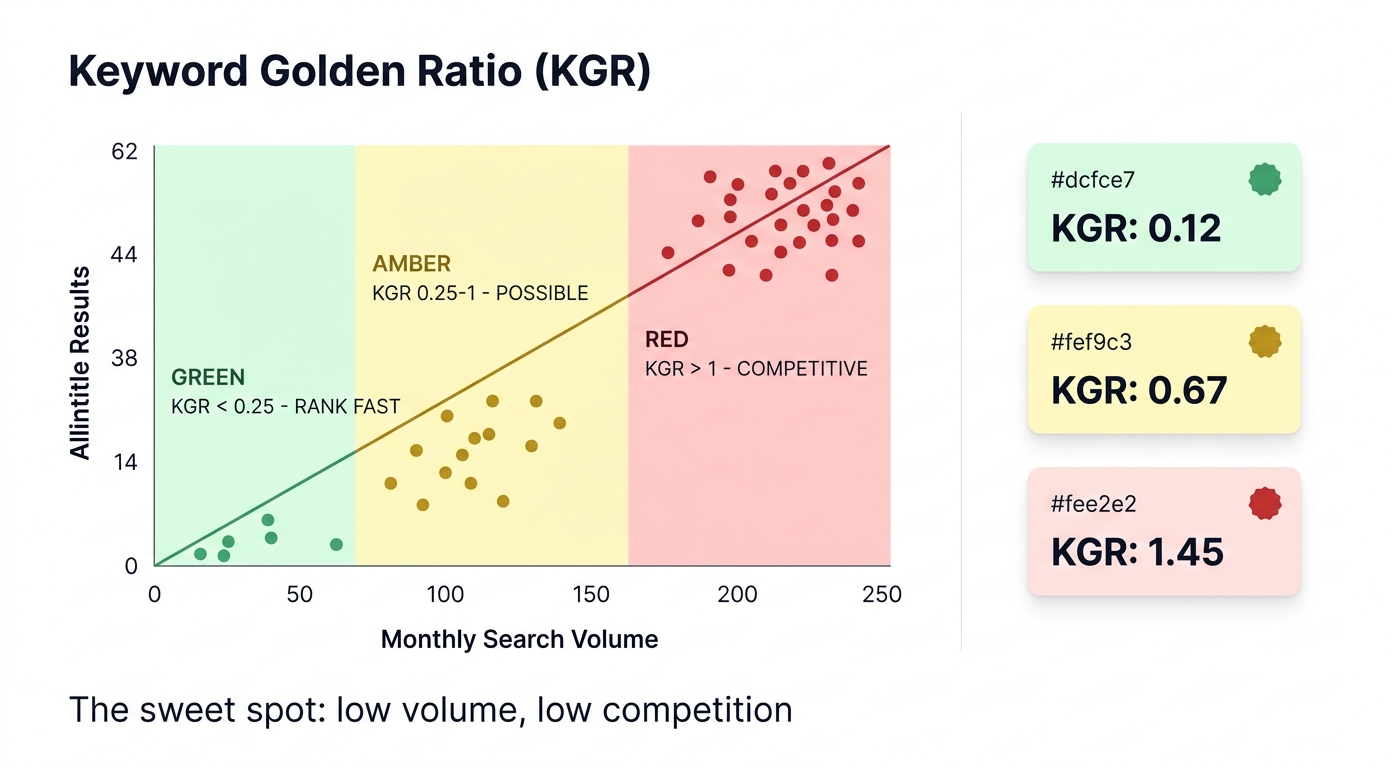
One rule decides whether KGR even applies: keep monthly search volume under 250. Cunnington capped it there deliberately. At 250 searches, a 0.25 ratio means you compete with at most about 62 pages, many of which are not truly optimised for the term anyway. Above 250, the method loses its edge and ordinary keyword difficulty takes back over.
What “Allintitle” Actually Counts
allintitle: is a Google search operator. Type allintitle:your keyword and Google returns only pages with that exact phrase in their title tag.
That number is the cleanest competition signal there is. A title tag is where a page declares what it is built to rank for, so the allintitle count is a headcount of pages deliberately targeting your keyword, not pages that merely mention it in passing.
Pulling those counts by hand is the catch. Google throttles repeated operator searches quickly; after a few dozen you are solving CAPTCHAs, and a list of 100 keywords becomes a lost afternoon. Automating the lookup is the only sane way to work at any real scale.
How to Run a KGR Check in Seconds
- Add a Google Custom Search API key and Search Engine ID (cx) once, and both are free to create. The tool saves them in your browser, so you only do this on the first run.
- Paste your keywords, one per line, up to 20 at a time. Long-tail phrases of three to five words are where KGR lives.
- Hit Analyse. Each keyword returns its exact monthly search volume, a live allintitle count, and a KGR score colour-coded green, amber, or red. Then export the lot to .xlsx.
No credits are deducted per keyword. Run the same list again tomorrow, or a hundred fresh ones. The math costs you nothing on our side.
Why Credit-Based KGR Tools Cost More Than They Should
Most bulk KGR checkers run on credits: every keyword you analyse spends one. A 200-keyword list costs 200 credits, and re-checking it next month costs 200 more, because allintitle counts drift over time and the numbers go stale.
| Feature | Credit-based KGR tools | Keyword Intent KGR Tool |
|---|---|---|
| Cost per keyword checked | 1 credit each | None |
| Re-running the same list | Costs credits again | Free, anytime |
| Daily and volume cap | Limited by credit balance | Unlimited on your plan |
| Search volume data | Estimates | Exact (Google Ads API) |
| Allintitle source | Their shared scrape | Your own Google Custom Search key |
| Bulk analysis | Yes (credits scale with list size) | Yes, 20 at a time, colour-coded |
| Export | Yes | Yes (.xlsx) |
Same allintitle data, same formula. The difference is whether you pay again every single time you press the button.
How to Use KGR Well, and Where It Breaks
KGR is a filter, not a promise. Three things keep it honest:
- The volume cap is a rule, not a suggestion. Score keywords under 250 monthly searches. Above that, the ratio stops predicting anything useful.
- It ignores who is ranking. A 0.10 KGR is worthless if the pages above you belong to Wikipedia and Amazon. A low headcount of strong opponents still beats you, so glance at the live SERP before you commit.
- Allintitle moves.Google’s counts wobble day to day. Treat a score as a strong signal, not a fixed fact.
And it compounds, or it does nothing. One KGR post barely registers; the well-known results came from publishing them by the hundred. The payoff is a library of low-competition pages, not a single lucky hit.
The method still holds in 2026. The specific, well-defined questions KGR surfaces are exactly what Google’s AI Overviews pull from and cite, so a clean, direct answer can earn visibility even where an answer box sits on top of the results.
What SEOs Say
“I was able to write a blog post outline within minutes using Keyword Intent that is 100% better than what an AI tool could provide. This has very quickly become my favourite keyword research tool, with long tail Keyword Golden Ratio and the Reddit Topic Hunter generating some cracking ideas for new content.”
Pair KGR With the Rest of Your Research
KGR is only as good as its denominator. An accurate volume number is the whole formula. Pull exact search volume, CPC, and hundreds of long-tail ideas from the free Keyword Research Tool, cluster them into topics with the Grouping Tool, then drop the under-250 candidates here to score them. For video, the YouTube Autocomplete Tool surfaces the long-tail phrases people actually type into YouTube.
Frequently Asked Questions
What is the Keyword Golden Ratio (KGR)?
KGR is a keyword research method created by Doug Cunnington that scores a keyword by how little competition it has relative to how many people search for it. The formula divides the number of Google results with the exact keyword in the title (allintitle) by the keyword’s monthly search volume. A score under 0.25 signals strong potential to rank quickly, even for new or low-authority sites.
What is a good KGR score?
Under 0.25 is the target, with a strong chance of reaching Google’s top 100 once indexed. Between 0.25 and 1 is harder but workable, with a realistic shot at the top 250. Above 1 means more pages target the keyword than the traffic justifies, so it is usually not worth chasing unless your domain is already strong.
What does allintitle mean in KGR?
Allintitle is a Google search operator. Searching allintitle:your keyword returns only pages with that exact phrase in their title tag. Because the title is where a page declares what it is built to rank for, the allintitle count is a precise headcount of the pages deliberately competing for your keyword.
Why must search volume be under 250 for KGR?
Doug Cunnington capped KGR at keywords with fewer than 250 monthly searches on purpose. At 250 searches a 0.25 ratio means you compete with at most about 62 pages, many not truly optimised for the term. Above 250 the method loses its predictive edge and ordinary keyword difficulty takes over.
How much does the KGR Tool cost?
It is included with a Keyword Intent subscription and charges no per-keyword credits, unlike credit-based tools where every keyword analysed spends one credit. Allintitle counts are pulled with your own Google Custom Search API key, which is free to create and includes 100 free queries per day from Google, so most KGR research costs nothing beyond your subscription.
How many keywords can I check at once?
Up to 20 keywords per run, with no limit on how many runs you make. Paste a fresh list whenever you want and re-check old ones for free, since the tool does not meter usage per keyword.
Does the Keyword Golden Ratio still work in 2026?
Yes. Finding keywords where demand outruns the supply of optimised content is a market dynamic that does not change with algorithm updates. The specific questions KGR surfaces are also the kind of content Google’s AI Overviews tend to cite, so a clean direct answer can earn visibility even where an answer box appears.
Does a low KGR guarantee a number-one ranking?
No. KGR is a filter, not a guarantee. It does not measure how strong the sites currently ranking are, so a low score is meaningless if pages like Wikipedia or Amazon hold the top spots. Always check the live SERP, write genuinely useful content, and treat KGR as one strong signal among several.
Paste your first list above. Exact volume, live allintitle, and a KGR score for every keyword, colour-coded, exportable, and never metered. Find the words your competitors skipped, before they come back for them.