Free Keyword Grouping Tool: Turn a Keyword List Into Topic Clusters
A keyword export with 300 phrases is not a plan. It is a wall. Half of those phrases are the same search wearing different words, and writing a page for each one is how a site ends up competing against itself.
Paste the list into the box above and it collapses into topic clusters in one click. Each group is a single page waiting to be written, and the largest group is usually your pillar. Grouping first is the difference between a content calendar and a guess.
What Is Keyword Clustering?
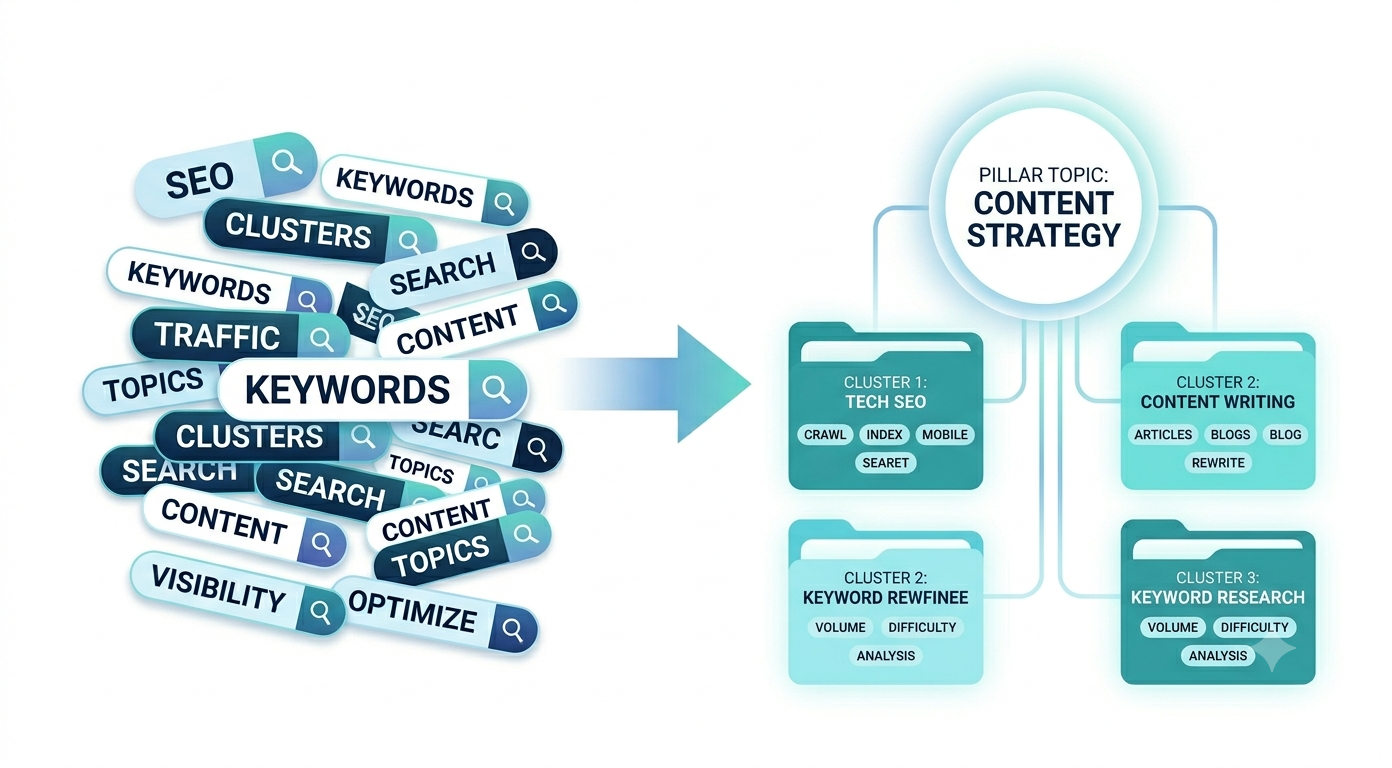
Keyword clustering is the practice of grouping keywords that share the same search intent so a single page can target all of them at once, instead of spreading thin pages across near-identical queries.
The reason it matters is mechanical. When Google returns almost the same ten results for “best seo agency new york” and “top seo agency in new york,” those two phrases want the same page. Build two pages and they split your authority and rank for neither. That self-competition has a name, keyword cannibalization, and clustering is how you avoid it before a word is written.
A cluster is therefore not a list of similar words. It is a decision: one intent, one page, every variation it can rank for folded in.
Topic Clusters and Pillar Pages: How They Fit Together
Clustering produces two kinds of pages, and the grouping tool surfaces both. Knowing which group is which is what turns a list of clusters into a site structure.
| Page type | Targets | Role | Which group it is |
|---|---|---|---|
| Pillar page | The broad head term | Covers the whole topic, links to every cluster | The largest group the tool returns |
| Cluster page | One long-tail variation | Answers one narrow query, links back to the pillar | The smaller, more specific groups |
The internal links carry the signal. When every cluster page links up to the pillar and the pillar links back down, Google reads the pillar as the authority on that subject. A flat pile of unlinked posts sends no such signal, which is why structure, not page count, is what moves rankings.
How to Group Keywords Into Clusters
The whole workflow is three numbers’ worth of effort: a list in, a structure out, a plan to write against.
- Paste your keywords into the box at the top of this page, one keyword per line. No account, no limit.
- The tool groups any phrases that share the same two or three words and shows each topic group with the keywords inside it.
- Filter to a single topic, copy a cluster to your clipboard, or export the whole set to an .xlsx file for your content calendar.
Need the list itself first? Run a seed term through the free keyword research tool, export the related ideas, and paste them straight in. Research and grouping are two halves of the same pass.
A Real Topic Cluster Example
Abstract definitions only go so far. Here is what the tool actually does. Start with 138 raw keywords from a single seed, “seo new york,” the kind of flat list any research export hands you:
The input: one flat list
Pasted into the tool, those 138 phrases resolve into clean topic groups. Four of them:
Cluster: SEO Agency
Cluster: Local SEO
Cluster: SEO Expert
Cluster: SEO Brooklyn
The broad “New York” group, the one that swept in nearly every phrase, is the pillar. The tighter groups beside it, agency, local, expert, plus borough pages for Brooklyn, Manhattan, and the NYC variants, are the cluster pages that link up to it. A wall of 138 keywords just became a structured site map, and the work took one click.
Why Grouping Before Writing Wins
The common workflow writes first and discovers the overlap later, usually when two posts start trading places in the rankings and neither holds page one. By then the fix means merges, redirects, and rewrites.
Grouping first inverts the order. You see the full shape of a topic before a single draft exists, so each page is scoped to one intent from the start, and the internal-link map is obvious because the clusters already point at their pillar.
Write first, group later
Group first, then write
The cluster model is not a trend. It is the structure search engines have rewarded for years, because topical depth plus clean internal linking is exactly what a page-by-page approach cannot fake.
Three Clustering Mistakes to Avoid
The tool does the grouping, but a few judgment calls stay yours.
- Treating every group as a page. A group of two near-duplicate phrases is not a page; it is two ways of saying the same thing. Fold tiny groups into the closest larger cluster.
- Missing two intents in one group. If a single cluster mixes “seo agency” and “seo expert,” split it. A buyer searching for an agency wants a firm; one searching for an expert wants a name. Shared words are a hint, not a verdict; intent is the real test.
- Forgetting the internal links. Clusters only earn their ranking power once each page links to its pillar and back. Grouping plans the structure; the links build it.
More Free Tools on Keyword Intent
Keyword Research Tool
The keyword research tool returns hundreds of keyword ideas with exact monthly search volume, CPC, and competition. Export the list, then paste it here to cluster it.
Keyword Golden Ratio (KGR)
The KGR Tool flags keywords where competing pages are few relative to search volume, the long-tail terms that fill out a cluster on a new site.
YouTube Autocomplete
The YouTube Autocomplete Tool pulls the exact phrases people type into YouTube search, a fresh source of keywords to group for video content.
Frequently Asked Questions
What is keyword clustering in SEO?
Keyword clustering is grouping related keywords that share the same search intent so they can be targeted by a single page instead of many thin pages. A cluster like “best seo agency new york” and “top seo agency in new york” belongs on one page because Google already ranks the same results for both. Clustering before you write prevents two of your own pages from competing for the same query.
What is a topic cluster?
A topic cluster is a content model where one broad pillar page links to several narrower supporting pages, and every supporting page links back to the pillar. The internal links tell Google the pillar is the authority on the topic. The grouping tool finds these clusters for you by reading the shared words across a keyword list.
What is a pillar page?
A pillar page is a broad, comprehensive page that covers an entire topic and links out to focused cluster pages on its subtopics. It targets the head term with the highest search volume, while each cluster page targets a long-tail variation. The largest group the tool returns is usually your pillar candidate.
How does the tool decide the clusters?
The tool reads the words shared across your keywords and groups any phrases that hold the same two or three words in common. A group only survives if at least three keywords fall into it, which filters out noise and leaves clusters big enough to justify a page. You get the group label and its member keywords, ready to copy or export.
How many keywords should be in one cluster?
Three is the working minimum and there is no hard ceiling. A cluster of three to fifteen tightly related long-tail keywords maps cleanly to one page. If a single group balloons past twenty, scan it for two distinct intents hiding inside and consider splitting it into two pages.
Is the keyword grouping tool free?
Yes. Paste any keyword list, group it, copy the results or export them to .xlsx, with no account, no daily limit, and no credit card. The grouping tool sits alongside the free keyword research tool on Keyword Intent.
Where do I get the keyword list to paste in?
Run a seed keyword through the free Keyword Intent research tool, which returns hundreds of related ideas with exact volume and CPC, then export or copy that list and paste it in. Any list works, one keyword per line, whether it came from Search Console, a competitor scrape, or a brain dump.
Paste your list above and watch it sort itself. No account, no limits. A flat keyword export becomes topic clusters and pillar candidates in the time it takes to read this sentence, the content plan written for you before you write a word.