Traffic vs Search Intent: Which Should Decide What You Target in 2026?
Every new SEO hits this fork. Do you chase the keywords with the biggest search volume, or the ones with clear intent even when the numbers are small? The advice splits both ways, which is why the question keeps coming up, and the loudest answers on either side are both a little too simple.
The honest answer is that it depends on how your site makes money, and for most sites the trap is the same one regardless. Traffic that does not match intent is a number that looks good on a dashboard and does nothing for the business. This piece is about when volume actually earns its keep, when intent should win, and how to tell which situation you are in.
Traffic Is a Means, Not the Goal
Start by naming what the site is actually for. It is leads, or sales, or signups, or something else you can point to. Traffic is not that thing. It is a step toward it, and a step is only worth what it leads to. A page can pull thousands of visitors and turn none of them into anything, which makes the traffic count look impressive and mean nothing.
That is why traffic on its own is a vanity metric. The number goes up, the screenshot looks good, and the business is exactly where it was. What decides whether traffic is valuable is the intent behind it. Visitors who were looking for what you offer do something after they land. Visitors who were looking for something else read and leave. Same visit count, opposite worth, and the difference is intent every time.
The Low-Volume Keyword That Outperforms
Take a narrow term like “markdown resume builder.” The search volume is tiny. But for a tool that builds exactly that, it converts far better than a broad, high-traffic term, because the intent is a precise match for the product. A few hundred visitors who searched that phrase are worth more than thousands who searched something vaguely adjacent, because they arrived already wanting the thing.
The reverse case makes it obvious. Picture a store that sells CBD flower. A thousand visitors for “snoop dogg net worth” is worthless to it, because not one of those people came to buy. Fifty visitors for “best cbd flowers” is money, because every one of them is shopping for what the store sells. Volume did not decide the value of that traffic. Intent did, and it was not close.
Same site, two keywords
This is the same reason a low search volume is not the disqualifier beginners treat it as. A term with modest or even near-zero reported volume can be the best keyword on your list if the intent is right, which our piece on low search volume keywords works through in full.
When Traffic Actually Is the Point
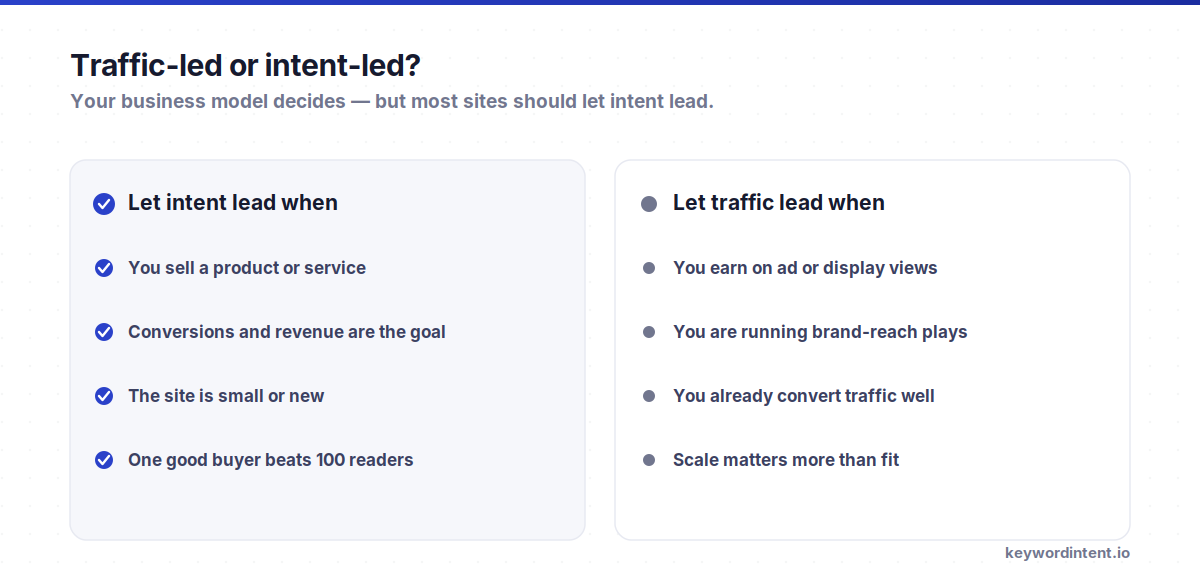
Now the honest caveat, because “intent always wins” is not quite true. For some sites, raw traffic is the product. If you run a content site that makes its money from display ads, sponsored posts, and brand deals, then a visitor is worth roughly the same whether they came to buy or came to read, because you are monetizing attention, not a purchase. For that model, a high-volume informational term is exactly the right target even though the buying intent is low.
On that kind of site you are judged by your stats, and the stats are the revenue. The same keyword that is a waste for an online store, the celebrity net worth term, might be a perfectly good target for a media site that earns per thousand impressions. The keyword did not change. The business model did, and the model is what decides whether volume or intent should lead.
The Answer, by Site Type
Stop asking “traffic or intent” in the abstract and ask it about your specific site. The answer falls out of how you get paid.
| If your site is | Lead with |
|---|---|
| An online store selling products | Intent. Match the buyer. |
| A software or service business | Intent. Chase the problem-aware. |
| A content site monetized by ads | Traffic, since attention is the revenue. |
| Sponsored posts and brand deals | Traffic and audience size, weighed with fit. |
| A lead-gen or local business | Intent. One good lead beats a crowd. |
Most people asking the question are in one of the intent-led rows, which is why intent is the safer default advice. But if you are in the traffic-led rows, following blanket “intent over everything” advice would have you ignore the terms that actually pay you. Know your model first, then the keyword strategy is not really a debate.
Intent First, Then Scale the Traffic
Even when you want volume eventually, the order that works is intent first. Start with the keywords whose intent matches your goal and get those pages actually converting. Prove the offer turns the right visitors into customers on a small, well-aimed set of terms. Only once that foundation is working do you scale traffic on top of it, expanding into broader terms knowing what a converting page looks like.
Doing it the other way around is the common failure. People chase the high-volume terms first, build a big traffic number, and then wonder why the revenue never follows. They scaled attention before they had anything that converted attention. Traffic added on top of a page that converts is growth. Traffic added on top of a page that does not is a bigger dashboard and the same empty pipeline. If you want a method for choosing which intent-matched keywords to build first, our guide to keyword prioritization lays out the order.
The AI-Answer Angle
There is a modern reason to favor intent that did not exist a few years ago. As more searches get answered by AI assistants that pull from web content, the pages most likely to be surfaced are the ones that directly satisfy the search intent behind the question. Fitting the intent closely is not just how you convert the visitor, it is increasingly how you get picked up as the answer in the first place.
That does not overturn the site-type framework, but it strengthens the intent side of it. A page built to answer exactly what someone is asking is well positioned whether a person reads it or an assistant cites it. A page built to grab volume with loosely relevant content is weaker on both counts. So even the traffic-led sites benefit from making sure the content genuinely matches the intent of the terms they target, rather than just appearing for them.
How to Decide in Practice
Turn the whole debate into a short sequence you can actually run against a keyword list.
- Name the conversion goal first. Lead, sale, signup, or ad impression. Everything else is judged against it.
- Decide your model. If you sell something, intent leads. If you monetize attention, volume earns a real seat at the table.
- Read intent on each candidate against that goal, using the SERP and the phrase shape to see who is really searching.
- Confirm commercial intent with the numbers. On the keyword tool, a healthy cost-per-click and competition mark the terms with buyers behind them.
- For a selling site, target the intent-matched terms first and get those pages converting before you widen the net.
- Then scale into higher-volume terms on top of what already converts, rather than starting from volume and hoping.
Frequently Asked Questions
Is traffic or search intent more important?
It depends on how your site earns. If you sell a product or service, intent matters more, because traffic that does not match the offer does not convert. If you make money from ads or sponsorships, raw traffic is closer to the actual product. Most people asking are in the first group, so intent is the safer default.
Why do low-volume keywords sometimes convert better?
Because a narrow term usually carries a precise intent. Someone searching an exact-match phrase for your product arrived already wanting it, so a small number of those visitors converts better than a large number who searched a broad, loosely related term. Intent, not volume, decides how valuable the traffic is.
Should I ever target high-volume, low-intent keywords?
Yes, if your revenue comes from attention rather than a purchase. A content site monetized by ads is right to chase high-volume informational terms even at low buying intent. A store or service business is usually wasting effort on the same terms, because the visitors are not there to buy.
Do I go after intent or traffic first?
Intent first in almost every case. Get a small set of intent-matched pages actually converting, then scale traffic on top of that foundation. Chasing volume before you have anything that converts just builds a bigger traffic number attached to the same flat revenue.
Does matching intent help with AI search answers?
It appears to help. AI assistants that pull from web content tend to surface pages that directly satisfy the intent behind a question, so a page built to answer exactly what is asked is well placed to be cited, not just to convert a human reader. Loosely relevant, volume-chasing content is weaker on both fronts.
How do I judge a keyword's intent quickly?
Read the results page and look at the phrase. If the top results are product and service pages, the intent is commercial. If they are guides, it is informational. A healthy cost-per-click and competition on the keyword tool confirm buyers are involved, while a near-zero CPC points to research traffic.
Traffic and intent are not really rivals once you know what your site is for. Attention-based sites can chase volume, but everyone selling something should let intent lead, target the matched terms first, and scale traffic on top of pages that already convert. Read intent on your list with the SERP and the numbers on the keyword tool, and let your business model, not a slogan, settle the rest.