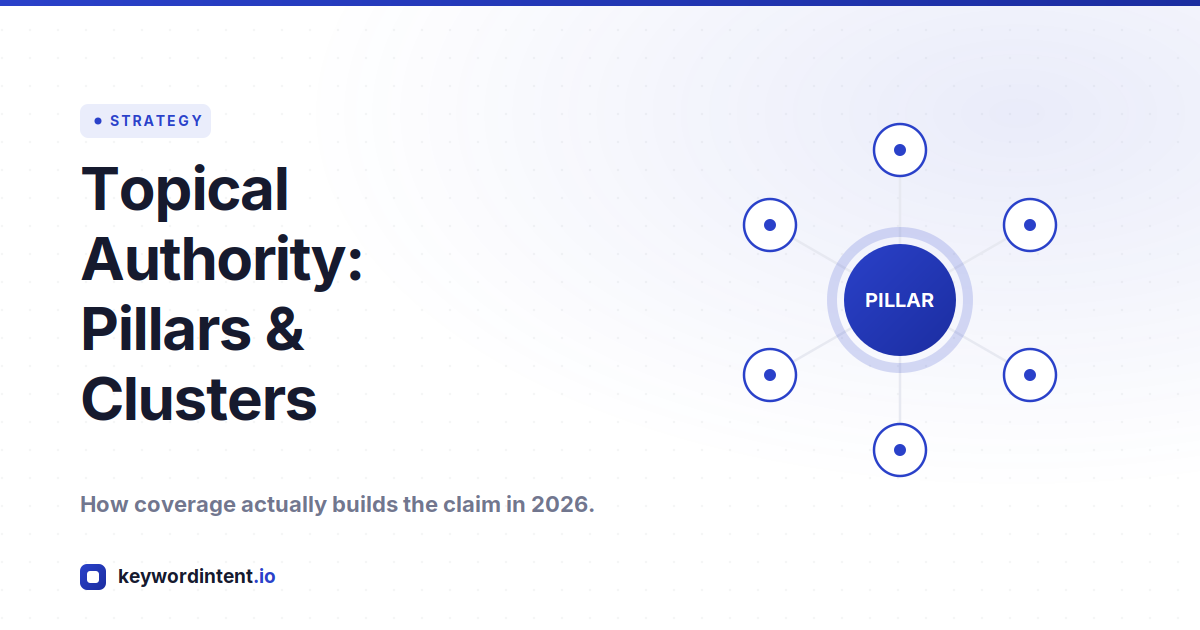
Topical Authority in 2026: How Pillar Pages and Clusters Actually Build It
A pillar page and a stack of cluster articles are not a content style. They are how you tell Google one thing convincingly: that your site covers a subject completely enough to be trusted on it. That trust has a name, topical authority, and it is one of the few levers a small site can pull without a large backlink budget.
The trap is treating the structure as the goal. Publishing a pillar and twenty linked posts does not hand you authority. It builds the claim. The authority arrives later, when those pages start earning clicks and a few relevant links point at them. This piece walks through how the pieces connect, and where the work actually pays off.
Pillar Page vs Cluster Page
Old SEO published one disconnected article per keyword. It worked for a while, then stopped, because a folder of unrelated posts says nothing about what your site is an expert in. The pillar-and-cluster model fixes that by splitting one job into two kinds of pages.
| Pillar page | Cluster page | |
|---|---|---|
| Role | Comprehensive overview, the hub | Deep dive on one narrow question |
| Scope | Broad, covers every aspect lightly | Narrow, answers one query fully |
| Keyword | Short-tail, high volume | Long-tail, lower volume |
| Intent | Exploratory, informational | Specific, often commercial |
| Links | Out to every cluster | Back to the pillar |
The cookbook analogy holds up. The pillar is the whole guide to a cuisine, broad strokes on techniques, ingredients, and regions. Each cluster is a single recipe, the carbonara done properly. The pillar is one component; the cluster set is the architecture around it.
What Topical Authority Actually Is
Topical authority is not a single score you unlock. It is what you get when three things keep reinforcing each other over time:
A useful way to frame the relationship: content is a claim to rank, not a cause of ranking. Coverage stakes the claim, linking strengthens it, and behavior is the signal that tells Google the claim was real. Build all three and authority compounds. Build only the first and you have a tidy site that ranks for nothing.
Why Structure Beats Raw Volume
The modern algorithm is, at its root, PageRank modified by topical relevance. Authority for a page comes from other pages that have traffic linking to it. Relevance comes from the words around those links, the anchor text, the title, the headings, and the body of the pages doing the linking.
That is why a pillar with linked clusters outranks a pile of standalone posts. When ten cluster pages link up to the pillar with descriptive anchor text, they tell Google what the pillar is about and pass along whatever traffic and trust they have. A flat folder of unconnected articles sends none of that signal. Each post fights alone, and the first stronger competitor knocks it out.
The hierarchy is simple. A pillar with a tight supporting cluster beats a bunch of smaller articles, which beats a pillar standing alone. More content is more lottery tickets, but only the structure turns tickets into a topic Google can read.
Building the Pillar Page
Pick one core topic that maps to a real part of your business, then write the page that covers all of it. The pillar targets a short-tail, high-volume term and reads like an A-to-Z guide: broad, complete, but shallow on each subtopic, because the depth lives in the clusters.
Before you write a heading, do the keyword and competition research. Build an exhaustive list of keywords for the topic and sub-categorize them. Map your H2s and H3s from that list and from what already ranks. The pillar tends to run long because it is genuinely comprehensive, often a few thousand words, but length is a result of full coverage, not a target to hit for its own sake.
The step most people skip is the one that matters most: for every subsection, name the use case behind it. A subsection that has a clear reader need expands naturally into its own cluster article or points to a product page. Map intent, not just keywords, and the page ranks the way you hoped instead of merely existing.
Building the Cluster Pages
Each cluster takes one subtopic the pillar mentioned and answers it completely. It targets a long-tail keyword tied to a specific question and serves one intent fully, the kind of page that should rank for “how to write a marketing email” under a content-marketing pillar.
A practical move from experienced operators: start with the pillar, give it two or three months, then write your clusters according to what happened. If the pillar already ranks first for a subtopic, you may not need a separate page for it. Writing one anyway can split the two pages against each other and do more harm than good. Let the results tell you which clusters to build.
One intent, one page. Two pages chasing the same query is cannibalization, and it leaves you ranking for neither. The Keyword Clustering Tool groups a keyword list by shared intent so you can see the clusters before you commit a single article to the calendar.
The Internal Links Are the Whole Point
This is the part that turns a folder of articles into a topic. The pillar links out to every cluster. Every cluster links back to the pillar. Where two clusters genuinely overlap, link them to each other, but only where the connection is real, never link for the sake of it.
Those links carry relevance and authority across the whole group. When one cluster earns traffic, the pages it links to inherit some of it. The anchor text you choose tells Google what the target page is about. A pillar sitting at the center of that web reads as the authority on the subject; the same pillar with no clusters linking up reads as one more isolated page.
Backlinks then amplify what the structure already built. You do not need links from the same niche, that part is a myth; relevance comes through the link itself and its anchor text. What matters is that the linking page has real traffic. A few quality links pointed at the pillar lift the entire cluster, not just the page they land on.
Clicks Are How Authority Shows Up
Coverage and links are inputs. Clicks are the output that confirms they worked. Getting clicks for a topic is the manifestation of topical authority, not a separate goal you chase on the side. When real people land on your pages and stay, you are watching the claim get validated.
Reading the signal on one page
There is no published threshold here; this is the genuinely unknown part of SEO. But the direction is reliable. Track clicks per query, not domain-authority scores, and you are measuring the thing that actually matters.
Where Low-Difficulty Keywords Fit
On a new site you have no authority to spend, so picking fights you can win matters. Low-difficulty, low-competition keywords are the early wins: queries where the top results are thin or outdated and a focused page can break in without links behind it.
Those wins are not the strategy by themselves. They are the first tickets in the lottery. Each one that ranks brings clicks, each click feeds the behavior signal, and that momentum builds the authority that eventually lets you take on harder terms. Fill out a cluster with low-difficulty long-tails, rank a few, and the whole topic gains ground.
To find them, the KGR Tool flags long-tail terms where competing pages are scarce relative to search volume, and the keyword research tool returns the volume, CPC, and competition you need to sort the gettable from the impossible. Score the list, take the weak-competition winners, and group them into the cluster before you write.
A Workflow That Holds Up in 2026
Put the pieces in order and the model stops being a content-calendar chore and becomes a process for building authority on purpose.
- Identify one core topic that maps to your business, the subject you want to own.
- Build an exhaustive keyword list around it, then cluster it by intent to see the pillar and its supporting pages.
- Map the pillar’s H2s and H3s from the research, attaching a use case to each subsection.
- Publish the pillar first. Give it two or three months and watch which subtopics it ranks for on its own.
- Write clusters for the subtopics the pillar did not capture, leaning on low-difficulty long-tails for early wins.
- Link every cluster up to the pillar and the pillar down to each cluster, then earn a few quality links to the pillar.
- Measure clicks per query, prune what stalls, and deepen what moves.
The Mistakes That Waste the Effort
- Building the structure and stopping. A pillar and its clusters are a claim, not a result. Without clicks and a few relevant links, the architecture sits idle.
- Thinking in keywords instead of topics. One keyword per page leads to thin, overlapping posts. Group by intent and let one page own every variation it can rank for.
- Writing clusters before the pillar proves itself. You may not need a separate page for a subtopic the pillar already ranks for, and forcing one risks splitting your own authority.
- Chasing domain-authority scores. Pursue links from pages with real traffic, not high vanity metrics. Traffic is the authority that transfers.
- Linking carelessly. Connect clusters only where they genuinely overlap. Excess internal linking muddies the signal instead of sharpening it.
Frequently Asked Questions
Are pillar pages still effective in 2026?
Yes, especially if you already have content to link together. The point of a pillar is to consolidate relevance and authority on a topic through internal and external linking. A pillar with a supporting cluster outranks a pile of standalone blog posts, and a pillar standing alone with nothing linking to it outranks neither.
What is topical authority, exactly?
It is not a single score. It is what emerges when coverage, linking, and user behavior reinforce each other over time. You answer a topic completely, connect those answers clearly, and earn clicks once people arrive. Google reads that combination as expertise and ranks you accordingly.
Can a blog article be a pillar page?
Yes. A pillar is defined by its role, not its template. Any comprehensive page that covers a broad topic and links out to narrower supporting articles can serve as a pillar, whether it lives under a blog or a service section.
Do backlinks need to come from the same niche?
No. The idea that Google requires niche-matched backlinks is a myth. Relevance travels through the link and its anchor text. What actually matters is whether the linking page has real traffic, since that is the authority and behavior signal that transfers to your page.
How do low-difficulty keywords help build authority?
On a new site they are the cheapest early wins. Ranking a few low-competition long-tails brings clicks, clicks feed the behavior signal, and that momentum builds the authority that lets you compete for harder terms later. Group them into a cluster rather than publishing them in isolation.
How do I know when a page has earned topical authority?
Watch clicks per query in Search Console rather than any single metric. Steady clicks for a target query over a few months signal that authority is forming. There is no published threshold; this is the genuinely unknown part of SEO, but the direction of the signal is reliable.
Pillar pages and clusters are not the strategy; they are the structure that makes the strategy legible to Google. Cover the topic completely, link the pages so relevance and authority flow between them, win early ground with low-difficulty terms, then measure the clicks that prove it worked. Start by clustering your keyword list and let the groups show you the pillar and the pages around it.