How to Actually Do SEO in 2026 with AI: A Simple Step-by-Step Process
Most SEO advice feels either outdated or impossibly complicated, and the arrival of AI made it worse, not better. Every thread has a different answer, half of it contradicts the other half, and you just want a clear, practical process one person can follow without a team or a stack of paid tools.
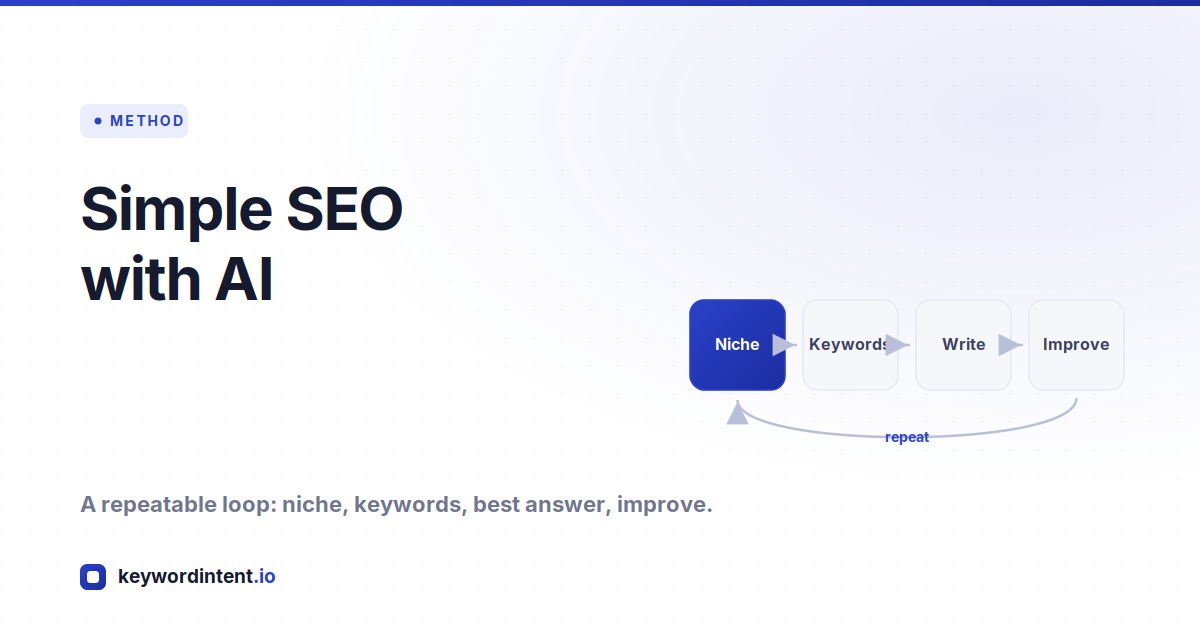
Here is the good news the noise buries: the fundamentals did not change. AI changed the tools, not the job. What follows is a simple loop you can run start to finish, where AI does the heavy lifting and your judgment does the parts AI cannot. Pick a niche, find the right keywords, write the best answer, structure it, connect it, publish, and improve. Then repeat.
Treat SEO as a Loop, Not a System
The reason SEO feels overwhelming is that people present it as one giant machine you have to build all at once. It is not. It is a small loop you run over and over, getting a little sharper each time. You do not need to master everything before you start. You need to complete the loop once, then do it again on the next topic.
Keep that framing and the AI question answers itself. AI is not a new strategy, it is a faster way through the steps you were already supposed to take. It drafts, it researches, it outlines. It does not decide what is worth writing or whether your page actually helps a person. That is still your call, and it is where the whole thing is won or lost.
Pick a Narrow Niche and Audience
The most common mistake is going broad. A new site cannot compete for “travel” or “fitness,” and trying to spreads you so thin that nothing ranks. Pick a specific slice and a specific person. Not travel, but budget travel for a particular region. Not fitness, but strength training for people over fifty.
Narrow is not a limitation, it is the strategy. A site that owns one small topic completely beats a site that touches a big topic shallowly, because search engines reward depth and relevance over breadth. You can widen later. First, become the obvious answer for one clear thing.
Find Keywords With Real Intent
Now find what your audience actually searches. Use AI to brainstorm the problems and questions in your niche, then validate them against real search data. Ask a model what people struggle with in your topic, pull autocomplete and People Also Ask, and read the communities where your audience hangs out. You are looking for specific, low-competition terms a new site can realistically win.
Here is the trap, and it is the one experienced people warn about most. Do not chase “low-competition” keywords blindly. An easy keyword with weak or mismatched intent brings weak traffic that does nothing. The step everyone skips is the sanity check: open the search results yourself and read the top pages. They are the search engine's own answer to what the searcher wants, and they tell you whether you can genuinely do better or are about to waste a good keyword.
Expanding a seed on the keyword tool gives you the volume, difficulty, and cost signals to separate buyers from browsers, and the wildcard filters pull questions, comparisons, and alternatives on purpose. For the full free approach to finding those terms, work through keyword research without paid tools, and for reading intent from the data and the SERP, see matching keywords to intent.
Write the Best Answer, Not Another Answer
Once you know the keyword and the intent, the content rule is simple. Your page should not be another version of what already ranks. It should be the best answer to that query, with something the others do not have. That extra something is what makes a search engine, and a reader, pick you over the page that got there first.
This is exactly where AI helps and where it fails. Let it build the skeleton: the outline, the structure, a first pass on the sections that are genuinely generic. Then do the part it cannot. Read the top pages, find the gaps they left, and fill them with your own examples, your own data, your own screenshots, and real experience. AI can assemble what is already out there. It cannot add what only you know, and that is what separates a page worth ranking from filler.
Divide the work by what each side is good at
Structure for Humans First, Then AI
A great answer buried in a wall of text helps no one. Structure it so a person can scan it and get what they came for fast, and the same structure happens to make your page easy for AI systems to read and pull from. You do not optimize twice. Clear beats clever for both audiences.
What good structure does
- Answers the main question near the top, before the reader has to hunt for it.
- Uses clear headings that name what each section covers, so the page is skimmable and machine-readable at once.
- Breaks dense points into short paragraphs and lists instead of one unbroken block.
- Adds a short FAQ for the follow-up questions, which doubles as clean, quotable answers for AI results.
Then handle the basics without overthinking them. Put the keyword in the title, the URL, and the intro naturally, write a real meta description, and add descriptive alt text to images. These are hygiene, not tricks. Do them once and move on.
Cluster Your Pages and Link Them
One page is a start, not a strategy. As you cover more of your niche, connect the related pages so they reinforce each other. This is how you build the depth that makes a small site outrank a big one on your topic: a main pillar page on the core subject, supporting pages on the specific questions under it, all linked together.
Internal linking is the underrated half of this. It passes relevance between your pages, helps search engines see the relationship between concepts, and guides readers to the next logical page. Grouping your keywords by shared topic first tells you what the clusters should be. The Keyword Grouping Tool handles that grouping, and topical clusters and keywords per pillar cover how the pieces fit into a structure a search engine can read.
Publish, Then Improve the Winners
Publish consistently, but not blindly. One well-made page beats five rushed ones, so protect quality over frequency. Then let the data tell you what to do next instead of guessing. Search Console shows which pages are gaining or losing impressions, and that is your signal.
The highest-leverage move in SEO is rarely a brand-new page. It is improving one that is already close. Find the pages picking up impressions but not clicks, or ranking on page two, and make them better: fill a gap, sharpen the answer, tighten the intent match. Updating a page that already has momentum usually beats starting from zero. That feedback loop, publish, measure, improve, is what compounds over months.
The Loop, in Order
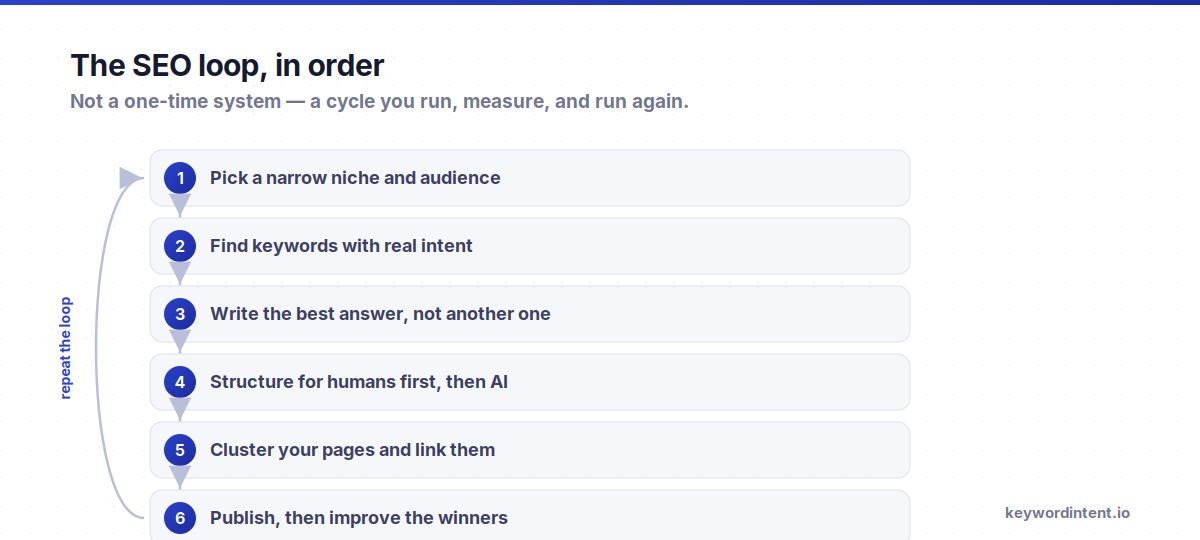
Put together, the entire process is short enough to hold in your head. Run it once, then run it again on the next topic.
- Pick a narrow niche and the specific person you are writing for.
- Find low-competition keywords with real intent on the keyword tool, and confirm intent by reading the SERP yourself.
- Write the best answer to each query, using AI for the skeleton and your own experience for the substance.
- Structure it for humans first, which makes it readable for AI too, then do the on-page basics once.
- Group related keywords with the Keyword Grouping Tool and link the pages into clusters.
- Publish consistently, watch Search Console, and improve the pages that are already close.
That is the loop. It is not a secret and it is not a hack. It is the fundamentals, run consistently, with AI making each pass faster.
Frequently Asked Questions
Do I need paid tools to do SEO in 2026?
No. Most paid tools aggregate public sources you can reach yourself. You can find keywords, read intent from the SERP, and track results in Search Console for free. Paid tools buy convenience and speed, not access. Start free and add tools only when a manual step becomes your bottleneck.
Can AI write the whole article for me?
It can write a draft, but a draft is not a page worth ranking. AI produces what already exists on the topic, which is exactly the generic content search engines are filtering out. Use it for structure and speed, then add the examples, data, and experience only you have. The human part is what makes it rank.
How long until I see results?
Usually months, not weeks, especially on a new site. New pages can show first impressions within a few weeks, but real traffic tends to build over three to six months of consistent publishing and improving. The people who win are the ones who keep running the loop instead of quitting at week four.
How often should I publish?
Consistently, at a pace you can sustain without dropping quality. One strong page a week beats five thin ones. Frequency helps, but only if each page is genuinely the best answer to its query. Depth in one niche matters more than volume across many.
Should I optimize for Google or for AI answers?
For both, and the good news is the same work serves both. Clear structure, a direct answer near the top, and genuine usefulness help you rank in search and get pulled into AI results. You are not choosing between two strategies, you are doing one well.
SEO in 2026 is not a maze, it is a loop: narrow niche, real-intent keywords, the best answer, clean structure, connected pages, and steady improvement, with AI speeding up every step and your judgment steering it. Start the loop by expanding a seed on the keyword tool, confirm the intent by reading the SERP, then group the results in the Keyword Grouping Tool and write the first page.