Search Intent: How to Match Keywords to Intent and the Right Page in 2026
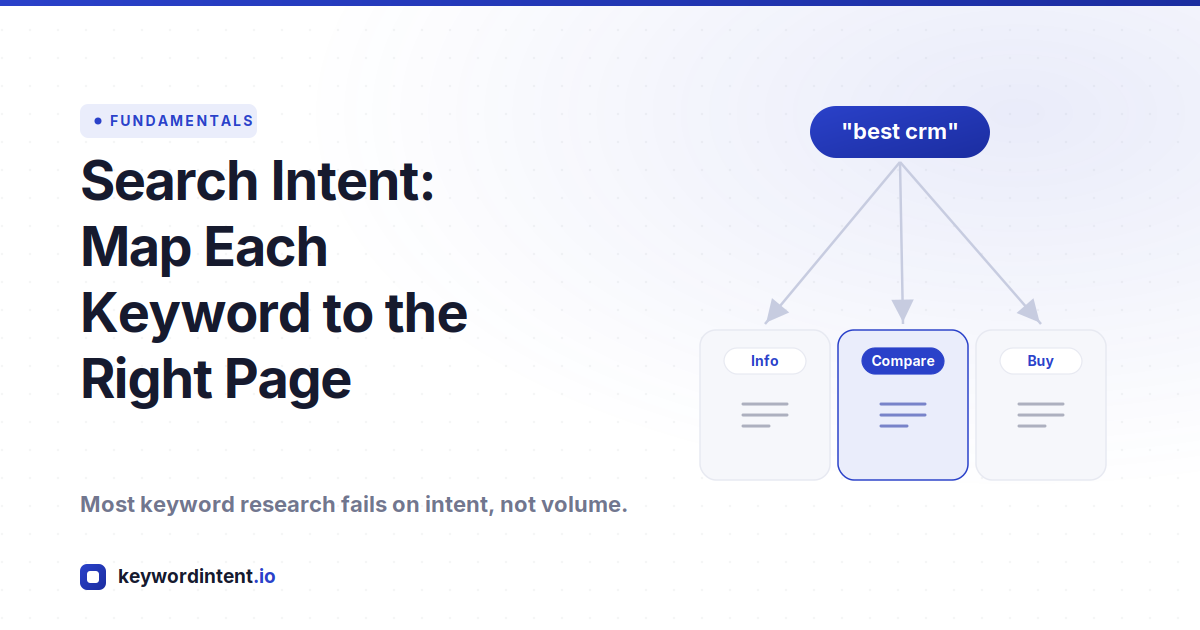
Most keyword research that fails does not fail on volume or difficulty. It fails on intent. You can target a phrase with real searches and beatable competition, write a solid page, and still convert nobody, because the people typing that phrase wanted something other than what your page offers.
Intent is the reason behind the search. Get it right and a modest keyword sends visitors who do exactly what you hoped. Get it wrong and a high-volume keyword fills your analytics with people who bounce. This piece covers how to read intent, how to spot it in the data, and how to send each keyword to the one page built to serve it.
Intent Is the Job Behind the Query
Every search is someone trying to get something done. A keyword is just the words they used to ask. Two people can type nearly the same words while wanting completely different outcomes, and the search engine has spent years learning to tell those outcomes apart.
That is the shift worth internalizing. Google does not rank the page that mentions the keyword most. It ranks the page that best satisfies the job behind the keyword. So your first research question is never “how do I work this phrase in?” It is “what is the person actually trying to do, and is my page the thing that does it?”
The Four Kinds of Intent
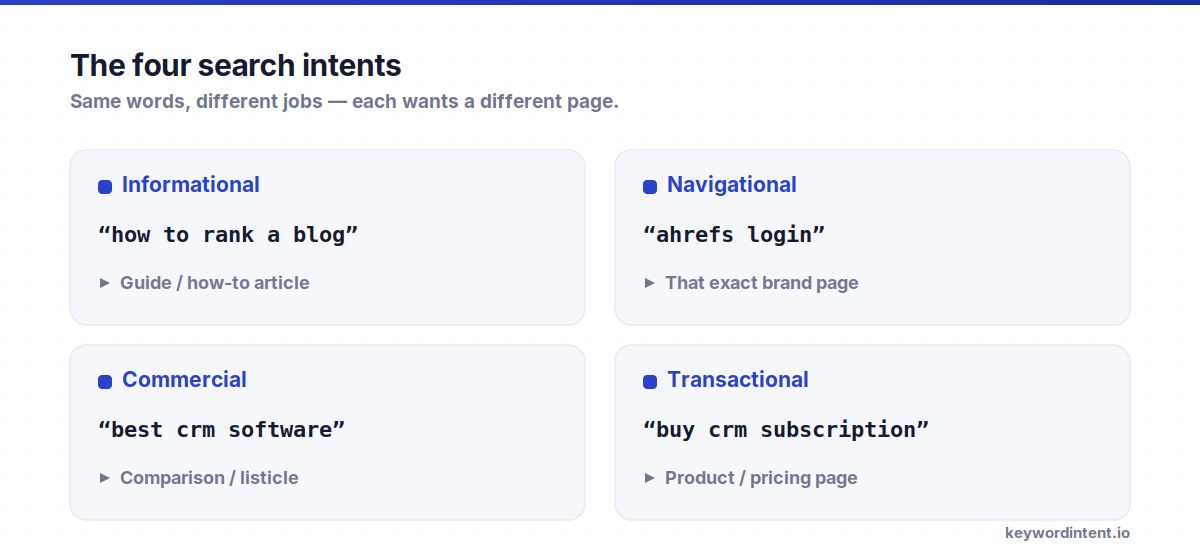
Almost every query falls into one of four buckets. Naming the bucket before you write tells you what the page has to be.
The four buckets
The line that matters most for a business is between the top two and the bottom two. Informational and navigational searches rarely buy on the spot. Commercial and transactional searches are where revenue lives. You need both, but you should always know which one a keyword belongs to before you build anything around it.
One Keyword, Two Different People
Here is the trap that confuses most beginners. Take a phrase like “software company.” One person searching it is starting a software company and wants advice. Another is a buyer looking to hire a software company for a project. Same two words, opposite goals. If you want the buyer, a how-to guide on founding a startup will pull the wrong crowd entirely.
The fix is rarely the broad phrase. It is the specific one. Buyers and learners almost always split into different long-tail queries, and the long tail is where intent becomes legible.
Same topic, intent made obvious
This is also how you move from a vague seed to keywords that earn customers. Starting from “crm software,” the searches worth owning are the ones that reveal a problem and a buyer: “crm software for non-profits” or “best crm features.” Each one tells you who is asking and how close they are to deciding.
The SERP Decides Intent, Not You
You can guess the intent of a keyword, but you do not get the final say. Google does, and it shows you its ruling on the results page. Open the search results for any keyword you are considering and read what already ranks. The pages on page one are Google's own answer to the question “what does this searcher want?”
If the top results are all buying guides and product pages, the intent is commercial, and a blog post will struggle no matter how good it is. If they are all how-to articles, the intent is informational, and your sales page will not break in. Match the format that is already winning. Fighting the SERP's established intent is one of the most common and most avoidable ways to waste a good keyword.
What experienced operators do
- Search the term yourself first and study the top five results before committing a single page to it.
- Match the dominant format on the SERP, a guide for guides, a comparison for comparisons, a service page for service pages.
- Treat a mixed SERP as a warning that the intent is split, and pick the slice you can actually serve.
- Mine real questions from forums and autocomplete to hear intent in the searcher's own words.
The Intent Signals Hiding in Your Data
You do not have to guess intent in the dark. The metrics next to a keyword carry signals, if you know what they mean.
A high cost-per-click and strong advertiser competition are the clearest tell that a keyword is commercial. Advertisers do not pay top dollar to reach people who are only browsing. When the keyword tool shows a healthy CPC and competition on a phrase, that is the market confirming buyers are on the other end. A near-zero CPC usually means informational traffic that will read and leave.
The shape of the phrase matters just as much. Modifiers like “how,” “what,” and “guide” lean informational, while “best,” “vs,” “alternative,” “price,” and “near me” lean commercial or transactional. The wildcard filters in the tool let you pull each kind on purpose: questions for the top of the funnel, comparisons and alternatives for the buyers further down.
Map Each Keyword to the Right Page
Once you know a keyword's intent, the page it belongs on stops being a guess. The question “homepage or about or contact?” answers itself when you ask what the searcher is trying to do.
| Intent of the keyword | Where it belongs |
|---|---|
| Broad commercial term for your core offer | Homepage or a primary service page. |
| Specific service or buyer phrase | A dedicated service or landing page for that offer. |
| Informational question in your niche | A blog post or guide that answers it fully. |
| Local or transactional intent | A location page or service page with a clear next step. |
| Your brand name and variations | Homepage and About. Do not chase these elsewhere. |
| Comparison or “best” query | A comparison or roundup page, not a sales pitch. |
A page like Contact almost never needs to rank for a research keyword. It serves people who already decided. So stop forcing keywords onto pages by location and start placing them by the job each page does. The homepage carries your strongest commercial term, service pages carry the specific offers, and the blog carries the questions that bring future buyers in early.
One Page, One Intent
A page tries to do one job well or several jobs badly. When you stuff a single page with an informational guide, a sales pitch, and a comparison all at once, it serves none of them cleanly, and Google cannot tell what it is for. Worse, two pages chasing the same intent compete against each other for the same slot. That is keyword cannibalization, and it usually leaves you ranking for neither.
The way to avoid it is to group your keywords by shared intent before you decide how many pages you need. Phrases that want the same thing belong together on one page. Phrases that want different things need different pages. The Keyword Grouping Tool clusters a list by shared intent so you can see those natural groupings before you commit anything to the content calendar. Pair it with topical clusters and each intent becomes its own well-aimed page inside a topic Google can read.
When Traffic Intent and Money Intent Collide
Informational keywords usually have the bigger numbers. That is the temptation. A “how to” guide can pull far more traffic than a narrow buyer phrase, which makes it easy to fill a whole site with content that attracts readers who will never become customers.
The answer is not to abandon informational content. It pulls people in early and builds the relevance that helps your commercial pages rank. The answer is to know the job of every page before you write it. If a page exists to grow an audience, low buying intent is fine. If it exists to convert, confirm the keyword sits where a buyer actually decides. Match the keyword to the goal first, then build the page.
What an Intent Mismatch Actually Costs
An intent mismatch is expensive in two directions at once. You lose the ranking, because Google sees visitors arrive and leave quickly and reads that as a page that did not satisfy the query. And you lose the conversion, because even the people who stay wanted something you are not offering.
The volume looked good, the difficulty looked manageable, and none of it mattered, because the one input you skipped was the only one the visitor cared about. Checking intent costs you a few minutes reading a SERP. Skipping it costs you the page.
An Intent-First Keyword Workflow
Put intent at the front of the process instead of the end and the whole thing gets sharper.
- Start from the buyer, not the keyword. Name the person you want and what they are trying to do before you open any tool.
- Build a seed list and expand it on the keyword tool, using the wildcard filters to pull questions, comparisons, and alternatives separately.
- Read intent from the data. Use CPC and competition to spot commercial terms and the phrase shape to spot informational ones.
- Open the SERP for each candidate and confirm the format that already ranks matches the page you intend to build.
- Group the keywords by shared intent with the Keyword Grouping Tool so each page serves one job.
- Map every group to the right page type, then write each page to do that one thing better than what currently ranks.
Frequently Asked Questions
How do I find the intent of a keyword?
Read the search results for it. The pages already ranking are Google's answer to what the searcher wants. If they are guides, the intent is informational. If they are product or service pages, it is commercial or transactional. Back that up with CPC and competition data, which run high when buyers are involved.
Should I target high-volume keywords or specific ones?
Target the specific ones when you want customers. Broad head terms are ambiguous and often mix learners with buyers, so they pull the wrong crowd. Long-tail phrases make the intent obvious and usually convert better, even though the volume looks smaller.
Which page should a keyword go on, homepage or a blog post?
It depends on intent. Your strongest commercial term goes on the homepage or a primary service page. Specific offers go on dedicated service pages. Questions and how-to searches go on blog posts. A page like Contact almost never needs to rank for a research keyword.
Can one page rank for two different intents?
Rarely, and it is not worth aiming for. A page that tries to serve a learner and a buyer at once usually serves neither, and Google struggles to classify it. Split the intents across separate pages and link them together instead.
What is keyword cannibalization?
It is when two or more of your own pages target the same intent and compete for the same spot. Google splits its trust between them and often ranks neither well. Group keywords by intent first so each page owns a distinct job.
Is informational content worth it if it does not convert?
Yes, as long as you know its job. Informational pages bring people in early and build the topical relevance that helps your commercial pages rank. The mistake is expecting a how-to guide to convert like a sales page. Use each for what it is good at.
Intent is the input that decides whether a keyword pays off, and it is the one most people skip. Name the searcher, read the SERP, confirm the signals in the data, and send each keyword to the page built to serve it. Start by expanding a seed list on the keyword tool, separate the buyers from the learners with the wildcard filters, then group them by intent in the Keyword Grouping Tool before you write a single page.