Is Off-Page SEO Dead in 2026? What Actually Moves Rankings Now
You spend months on directory submissions, profile links, social bookmarking, and forum links, and the rankings do not move an inch. At some point the honest question surfaces: does off-page SEO still work at all, or have you been grinding on something the search engines stopped counting?
Short answer: those specific tactics are mostly dead, and several of them were dead long before 2026. But off-page SEO itself is not. It shifted from a volume game into an earned-relevance game, and the methods that stalled were the ones that never really carried weight to begin with. Here is what stopped working, what still does, and where it all sits next to your content.
The Tactics That Stopped Working
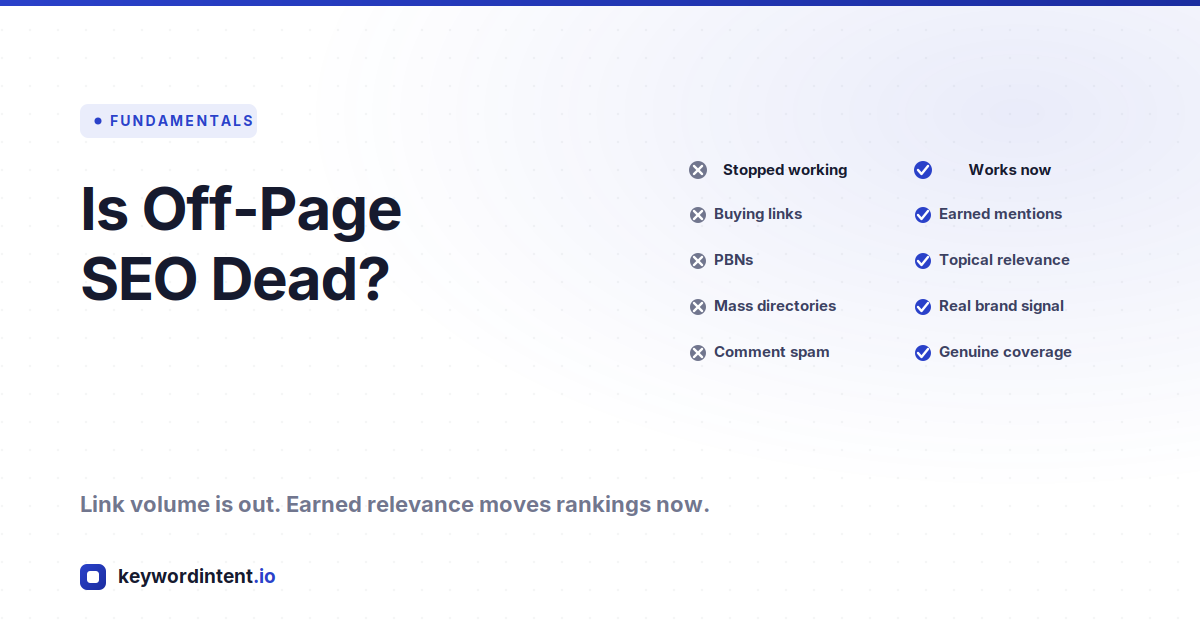
The methods a lot of people picture when they hear “off-page SEO” are exactly the ones search engines learned to ignore years ago. Directory submissions, profile links on random sites, social bookmarking, and pasting your URL into forum comments were all built to manufacture links at volume. They passed a weak, arbitrary signal, and once the systems got good at spotting manufactured links, that signal fell to near zero.
What is not moving your rankings
If you have been running these and seeing nothing, the algorithm update is not the reason. The tactic is. It is worth saying plainly, because it saves you from hunting for a fix to a method that has been coasting on borrowed time for a decade.
From Volume to Earned Relevance
Off-page SEO used to reward quantity. More links, higher rankings, within reason. That is the era those tactics belong to. Then the web got bigger, the systems got smarter, and a link stopped being a vote you could win by stuffing the ballot box.
A link now has to carry more than the fact that it exists. It has to sit in real context, on a page that has its own audience and its own reason to mention you. The signal is closer to a recommendation than a raw count. That is why a single editorial mention from a site people actually read can outweigh a thousand manufactured links, and why the thousand manufactured links are quietly filtered before they ever count.
It is also why the honest voices keep pointing out that the boring, legitimate placements still move rankings while the pile of directories never did. It was never the number. It was whether anyone credible was willing to point at you.
What Actually Earns Off-Page Authority
If manufactured links are out, the replacement is not a shinier trick. It is the slower work of becoming worth mentioning in the first place.
What actually earns links and mentions now
- Editorial mentions. Being cited in a genuine article on a site with its own readership, because your page is the best thing to point at.
- Digital PR. Creating something worth covering, original data, a useful tool, a real story, and putting it in front of the people who write about your space.
- Genuine community presence. Being useful in the niche forums where your buyers already are, so mentions happen because you earned trust, not because you pasted a link.
- Brand signals. Enough people searching and talking about your name that search engines treat you as an entity worth surfacing.
None of this is fast, and that is the point. The reason it works is the same reason it is hard to fake. You cannot mass-produce a real recommendation, which is exactly why a real one still counts.
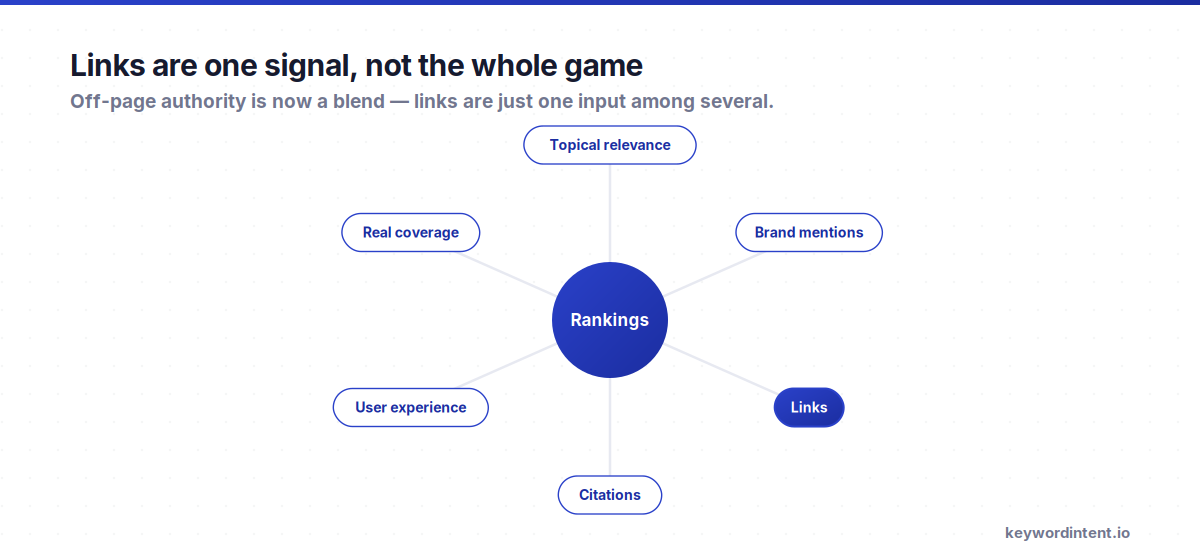
Links Are One Signal, Not the Whole Game
It is easy to swing from over-valuing links to declaring them dead. Both are wrong. There is a long-running argument between people who say backlinks are the foundation of rankings and people who say good content is all you need, and the useful answer sits between them.
Authority does not come from one place. Links are one route to it. Coverage of a topic, internal structure, brand searches, and genuine usefulness are others. Links can speed up how fast you build authority, but they do not substitute for having something worth ranking underneath them. Build only links and you have pointers to a page that does not deserve the spot. Build only content and you can stall, because in a competitive market plenty of good pages never crack the top few without some external signal that you are credible. This is the same tension we pull apart in does search intent actually matter, from the ranking side rather than the link side.
| The common claim | What actually holds up |
|---|---|
| Off-page SEO is dead | The old volume tactics are. Earned mentions and relevance are very much alive. |
| Backlinks are the foundation of rankings | They matter, more in competitive niches, but authority has several sources and links are one of them. |
| Good content ranks on its own | Often true in easy niches. In hard ones, strong pages still need external credibility to break through. |
| Any link helps | Manufactured links are discounted or ignored. Context and relevance decide whether a link counts at all. |
So the question is not links versus content. It is whether you are building something worth pointing at, and then earning the pointers. Skip either half and the other half underperforms.
How to Judge a Link Opportunity
If earned mentions are what count, you need a way to tell a good opportunity from a waste of time, and the metric most people reach for, a domain authority score, is the wrong one. A high score on a site nobody visits does little for you. A simpler filter comes up again and again from experienced operators: look at whether the specific page that would mention you gets real organic traffic.
A link from a page that ranks and receives actual search visitors passes something real: relevance, referral traffic, and a signal from a page the search engine already trusts. A link from a page with no traffic, however high the domain's score, mostly just sits there. Judge the page, not the domain.
A quick way to vet a placement
- Check the specific page's own organic traffic, not just the domain's authority score. A page with visitors is a page that counts.
- Ask whether the mention would sit in real context, next to content about your topic, or float in a list of unrelated links.
- Prefer relevance over raw metrics. A smaller, on-topic site your buyers actually read beats a big, generic one they do not.
- Treat referral traffic as the tell. If a link could plausibly send you real visitors, it is the kind search engines tend to value too.
This also reframes what “a link passes information now” means in practice. It is not mystical. A contextual mention on a trafficked, relevant page carries the weight of a recommendation. A manufactured link on a dead page carries nothing, which is exactly why the volume tactics stopped working.
Off-Page Works Better on the Right Foundation
Off-page effort compounds when it points at pages that were worth building in the first place. A mention that sends people to a page targeting a real query, answering it better than what already ranks, turns into rankings and visitors. The same mention pointing at a thin page aimed at nothing does almost nothing.
That is where the upstream work matters. Before you chase a single link, you want to know which topics have real demand, which keywords a page can realistically win, and how those pages connect into a topic search engines can read. Expanding a seed list on the keyword tool tells you where the demand actually is, and building those pages into topical clusters gives your off-page signals something solid to land on.
One more distinction worth drawing. If your real interest in off-page is showing up inside AI answers rather than classic search rankings, that is a related but separate game, and it rewards slightly different things. We pull that apart in citations vs backlinks for AI search. For traditional rankings, the rule holds: off-page authority amplifies what is already there. Point it at the right pages and it works. Point it at filler and no amount of link building saves it.
Frequently Asked Questions
Are backlinks still a ranking factor in 2026?
Yes. Links remain one of the signals search engines use, and they matter more in competitive niches. What changed is that manufactured, low-context links are discounted, so quantity on its own does very little.
Do directory submissions do anything?
Very little for rankings. A listing might move a third-party authority score slightly, but it sends almost no real traffic and carries little weight. Your time is better spent earning mentions on sites people actually read.
Is content enough to rank without any links?
Sometimes, especially in low-competition niches where few strong pages compete. In harder markets, good content often still needs external credibility to break into the top results. Treat content as necessary and links as an accelerant.
How many backlinks do I need?
There is no number that matters on its own. One relevant, contextual mention from a credible site can outweigh hundreds of manufactured links. Chase relevance and context, not a count.
Is guest posting dead?
Not if it is real. A genuine article on a relevant site with its own readers still earns both a mention and referral traffic. Mass, spun guest posts placed only for a link are the version that stopped working.
Off-page SEO is not dead. The volume tactics that gave it a bad name are, and most of them were fading long before this year. What earns authority now is being worth mentioning, and then earning the mentions from people your audience already trusts. Underneath all of it, you still need pages worth pointing at. Start by finding where the real demand is on the keyword tool and building those pages into topical clusters, so every mention you earn lands on something built to rank.