Low Search Volume Keywords in 2026: Are They Worth Targeting?
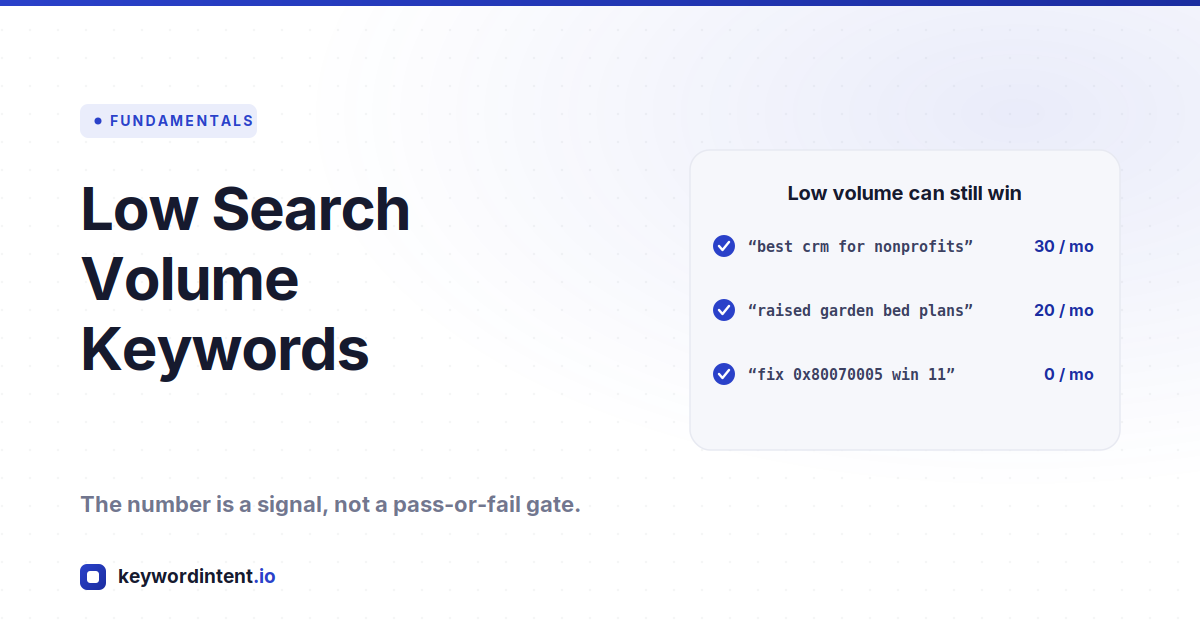
Short answer: yes, low search volume keywords are usually worth targeting, and filtering your list by volume alone is the most common way to throw away your best opportunities. The volume number is a rough, lagging estimate, not a measurement, and a phrase searched thirty times a month can be worth more than one searched five thousand times when the intent is sharper and the competition is thinner. Even zero-volume terms can pay off, because a tool showing no data does not mean no one is searching.
The trap is easy to fall into. You research a niche, every keyword with real volume sits at ninety-plus difficulty, and everything you could actually rank for shows almost no searches. It feels like there is nothing to target. There is, but only if you stop treating the volume column as a pass-or-fail gate. Here is what the number really means, when low volume is a green light, and the narrower cases where it is genuinely a dead end.
What Search Volume Actually Is
Search volume is not the count of people searching for a term. It is the count of searches, which is not the same thing, since one person can search the same phrase several times. It is also rounded and reported as an annual monthly average, so it smooths out seasonal spikes and will never exactly match the impressions you see in Search Console for the same query.
On top of that, it is a third-party estimate. Every tool models it differently, which is why the same keyword can read as a few hundred in one tool and over a thousand in another, and why many tools now show a bucket like “under 1,000” instead of a precise figure. And not every search becomes a click. The number is a direction, useful for telling whether a term sits in the tens, the hundreds, or the tens of thousands. It is not a guarantee, and treating it as one is where the trouble starts.
Why the Volume Filter Costs You the Best Keywords
Here is the dilemma that stalls a lot of keyword research. You are working a serious topic, say mental health, and every term with meaningful volume, something like “depression,” sits at ninety to a hundred difficulty. The terms you could realistically rank for show next to no searches. So you conclude that high-difficulty terms are not worth the effort and low-volume terms are a waste, which leaves you with nothing.
That conclusion is the mistake. A term is high-volume precisely because everyone wants it, which is exactly why a new site cannot rank for it. A term is low-volume and uncrowded for the same reason in reverse. The volume that looks too small to bother with is often the only volume you can actually capture. Dismissing it on size alone throws away the part of the market that is open to you and keeps you reaching for the part that is not.
Small Numbers Add Up Faster Than You Think
One keyword at twenty searches a month is not a business. A hundred of them is. Cover enough low-volume terms and you are looking at two to five thousand highly relevant visits a month, from people with specific needs who convert better than a vague head-term audience ever would. The volume you wrote off as too small adds up the moment you stop counting it one term at a time.
The traffic is only part of it. Every low-volume page you rank builds topical authority in the subject, which makes the next term easier and, eventually, brings the high-volume, high-difficulty terms into range. You do not beat the hard keywords by attacking them head-on as a new site. You earn them by stacking enough of the easy ones first. The same idea drives the case for long-tail keywords, which is where most low-volume terms come from.
When the Tool Says Zero
A reading of zero or “no data” rarely means literally nobody searches the term. More often it means the phrase is new, too specific for the tool's sample to register, or spelled in a variant the tool counts separately. A real, gettable keyword can hide behind a zero simply because the tool has not caught up to it.
The clearest version of this is a term that did not exist yet. During the early days of COVID, a phrase like “social distancing” paired with an activity showed no data anywhere, because it was too new to have history. Pages that targeted it ranked first and pulled real traffic the moment demand caught up. The tool was not wrong about the past, it just could not see the present.
How to validate a zero-volume term
- Type it into Google. If it autocompletes or triggers People Also Ask, real people are searching it.
- Look at who ranks. If dedicated pages target the term, there is demand a tool is not reporting.
- Check a spelling variant. “Non profits” and “nonprofits” can carry very different reported volumes for the same intent.
- Take the top result's URL into a tool and see how much traffic that page earns. A no-data keyword on a high-traffic page is a signal.
When Low Volume Is a Green Light
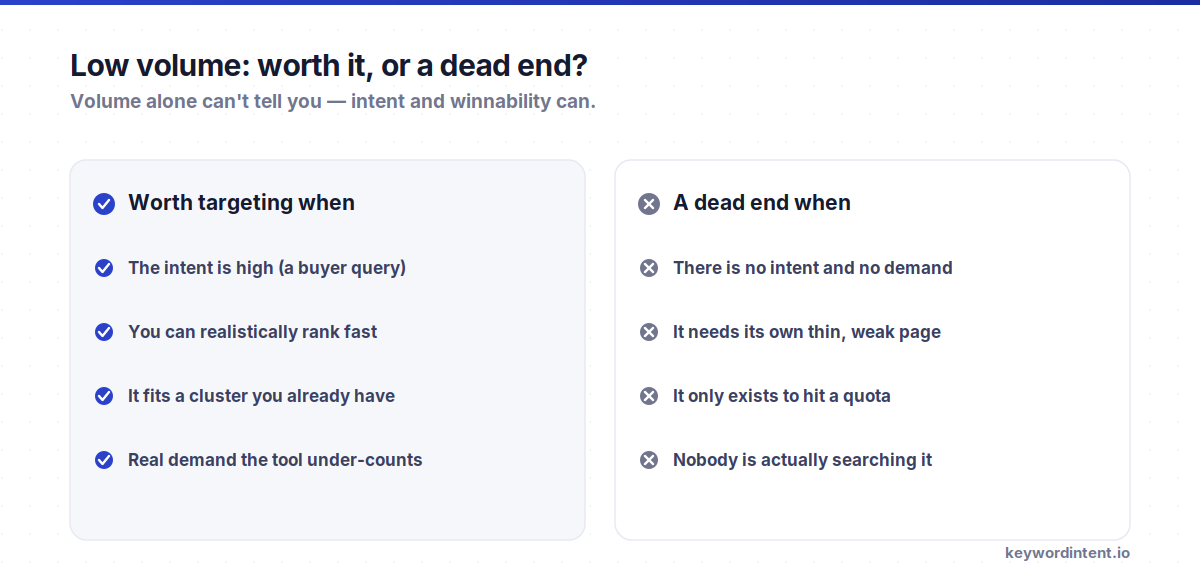
Low volume is a reason to target a term, not avoid it, in these cases:
- The intent is specific and close to a decision. A narrow phrase pulls a reader who knows what they want, and converts well despite the small audience.
- It names a problem you actually solve. If your product or content is the answer to the search, even a handful of visits a month can be worth real money.
- It slots into a cluster you are building. A term that strengthens a topic is worth more than its own traffic, because it props up the pages around it.
- It is an emerging term. Getting there before the volume and the competition arrive means you own the page when demand shows up.
When Low Volume Really Is a Dead End
Low volume is not always worth chasing, and pretending otherwise wastes effort too. Skip a term when:
- A one-line answer resolves it. If an AI Overview or a featured snippet fully answers the query on the results page, you can rank and still get no click.
- There is no buyer and no path to one. Pure brand-awareness traffic with nothing behind it, no product, no email capture, no next step, rarely earns its keep.
- Nobody searches it and it builds toward nothing. A genuinely dead term that does not support a larger topic is just an empty page on your site.
- It duplicates something you already cover. If the same results rank for two phrasings, one page serves both, and a second only splits them.
Stop Filtering on a Single Number
Volume alone is a bad filter. So is difficulty alone. The people who only chase low-difficulty terms make the mirror image of the volume mistake, and end up with a pile of easy pages that bring the wrong audience or no audience at all. No single column should decide what you write.
The real filter is intent and business value, with volume and difficulty as inputs rather than gates. A low-volume, low-difficulty, high-intent term beats a high-volume, high-difficulty, vague one for almost any new site, and the only way to see that is to weigh all of it together. The keyword difficulty guide covers the other half of this, and keyword prioritization turns the judgment into an order you can act on.
How to Judge a Low-Volume Keyword
When a term looks too small, run it through this before you write it off.
- Read the intent first. Decide what the searcher wants and whether you can serve it better than what already ranks.
- Open the results. If a snippet or AI Overview answers it in a line, expect few clicks; if real pages rank and one is beatable, it is live.
- Confirm the term is real, especially when the tool shows zero. Check autocomplete, People Also Ask, and whether a ranking page earns traffic.
- Ask what it is worth. Is there a buyer, or at least a clear next step toward one, behind the search?
- Check whether it builds a cluster. A term that strengthens a topic you are growing is worth more than its standalone volume.
- Group it with its near-duplicates on the Keyword Grouping Tool so a dozen tiny terms become one page strong enough to rank.
Frequently Asked Questions
Are low search volume keywords worth targeting?
Usually, yes. They face thinner competition, carry sharper intent so they convert better, and add up across many terms while building topical authority toward harder keywords. For a new or niche site, low-volume terms are often the only ones you can realistically rank for.
What does zero search volume mean?
Usually that the term is new, too specific for the tool's sample, or tracked under a different spelling, not that nobody searches it. Validate by searching the term, checking for autocomplete and People Also Ask, and seeing whether real pages target it.
Is search volume or keyword difficulty more important?
Neither on its own. Filtering by volume alone or difficulty alone both lead you wrong. Intent and business value decide what to target, with volume and difficulty as supporting inputs. A specific, winnable, high-intent term beats a big vague one for most new sites.
How much search volume is enough for a new blog?
There is no fixed floor. A cluster of low-volume terms that you can rank and that match real intent beats one high-volume term you cannot reach. Judge by whether you can win the term and whether the traffic is worth something, not by a minimum number.
Why does search volume differ between tools and not match Search Console?
It is a rounded annual monthly average and a third-party estimate, so each tool models it differently and many show ranges rather than exact figures. Search Console reports actual impressions on a different basis, so the two will rarely line up.
When should I skip a low-volume keyword?
When a one-line AI Overview or snippet fully answers it, when there is no buyer and no path toward one, when genuinely nobody searches it and it builds toward nothing, or when it only duplicates a term you already cover with the same results ranking.
Search volume is a compass, not a verdict. The terms that look too small to bother with are often the only ones a new or niche site can rank for, and they convert better because the intent is sharper. Read the intent, confirm the term is real, ask what the visit is worth, and let volume be one input among several. Find specific, intent-led terms on the keyword tool, validate the borderline ones against the results page, and group them with the Keyword Grouping Tool so a pile of low-volume phrases becomes a page worth ranking.