Long-Tail Keywords in 2026: What They Are and Why They Win for New Sites
A long-tail keyword is a specific, lower-demand search phrase, and the definition you have probably read, anything with three or more words, is a rough proxy that gets the idea half right. Length usually comes with specificity, but the thing that actually makes a keyword long-tail is how precise the intent is and how few people search it in that exact form. For a new or low-authority site, these are the terms you can realistically win, and the place every honest ranking plan starts.
The mistake is treating long-tail as a consolation prize, the scraps you target because the big keywords are taken. They are not scraps. A focused phrase pulls a reader who knows exactly what they want, faces far less competition, and adds up across dozens of variations into traffic that can rival a single head term, usually with better conversions. This piece covers what counts as long-tail, why it wins, how to find these phrases, and how to use them without wrecking your writing.
What Actually Counts as Long-Tail
The popular rule is that three or more words makes a keyword long-tail. It is a useful shortcut, because specific phrases do tend to be longer, but word count is the symptom, not the cause. The real markers are specificity and low, distributed demand. A short phrase can be long-tail if it is precise and rarely searched, and a four-word phrase can be a broad head term if huge numbers of people type it.
Same topic, three different keywords
So when a guide tells you to count words, read it as a hint. The keyword you want is the one narrow enough that the person searching has a clear need, and uncrowded enough that your page has room to rank.
The Curve That Gave It the Name
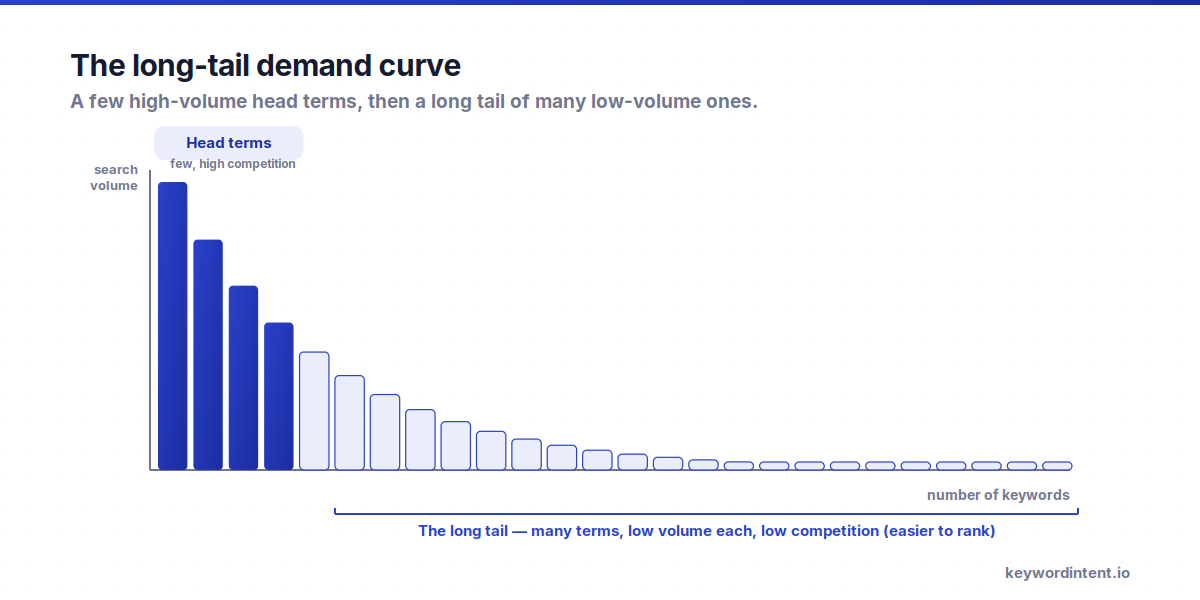
The term comes from the shape of a search-demand graph. Sort every query in a niche from most searched to least and plot it. A small handful of head terms get an enormous spike of volume on the left, then the line drops fast into a long, flat tail of countless specific phrases, each searched only a little. That tail stretches on almost forever, which is where the name comes from.
The part that matters is what the tail adds up to. Each phrase in it is tiny, but there are so many of them that, taken together, they account for the majority of all searches. Long-tail is not the leftover slice of search demand. It is most of it. The head terms are the small, crowded minority everyone fixates on, while the real volume sits spread thin across the phrases almost no one bothers to target.
Why Long-Tail Wins for a New Site
Ranking is a contest, and on a head term you are entering it against every established site in the niche, all of them with more links, more history, and more trust than a new domain has. You will not win that fight early, and chasing it burns months for nothing. A long-tail phrase is uncrowded for a simple reason: it is too small for the big sites to bother building a dedicated page around, which leaves the door open for you.
Picture a lawyer in New York trying to rank for “lawyer.” Hopeless. But a dedicated page for a Manhattan motorcycle injury claim, a hyper-specific service almost no competitor has written a full page about, is winnable from a standing start. A top-three spot for something searched thirty times a month beats page ten for something searched five thousand times, because page ten gets no clicks at all. You start where you can actually win, then climb.
That climb is the whole strategy. Each long-tail page you rank builds topical authority in the subject, which makes the next, slightly harder term easier, and eventually brings the head term you wanted on day one within reach. The KGR method is one disciplined way to find the low-competition terms to start with.
The Intent Is Sharper, So It Converts
A head term is vague by nature. “Dog brush” could be someone researching grooming, comparing types, or ready to buy, and you cannot tell which. A long-tail phrase removes the guesswork. Someone searching “shampoo mixer dog washing brush” is not browsing, they want precisely that product. The phrase tells you who they are and how close they are to acting.
That sharper intent is why low volume can still be worth more per visit. Ten people who know exactly what they want are often worth more than a thousand who are loosely curious. A specific phrase pulls a reader who is closer to a decision, so even a term with little volume can drive leads or sales out of proportion to its size. Volume measures how many people search. Specificity measures how ready they are, and for a business the second number usually matters more.
Low Volume, But It Adds Up
One phrase searched thirty times a month is nothing on its own. That is the reason people dismiss long-tail, and the reason they are wrong. You do not target one of these terms, you target a hundred. A hundred phrases at twenty to fifty searches a month is two to five thousand highly relevant visits, and they convert better than the one ambiguous head term you could not rank for anyway.
The traffic is only half the payoff. Cover enough closely related long-tail terms and you stop being a new site in that topic. The relevance you build makes each subsequent term easier to rank and slowly puts the high-volume, high-competition keywords on the table. The math is the same either way: a pile of small, winnable terms beats one big term you can only watch from page ten. If you have ever been told a keyword has too little volume to bother with, the low search volume keywords guide is the longer answer.
How to Surface Long-Tail Phrases
The phrases are everywhere your audience already types and talks. Google autocomplete is the fastest source: type your seed, then run through the alphabet a letter at a time and watch the specific completions appear. People Also Ask and the related searches at the bottom of the results page hand you more, in the exact wording Google associates with the topic.
Question stems are a reliable shortcut, because most long-tail searches are questions. People reach for how, why, where, which, and what, roughly in that order of frequency, so pairing those with your seed surfaces a long list quickly. Modifiers do the same job for commercial terms: best, vs, for, near, without, and cheap each open a different specific angle.
Where the real phrasing lives
- Autocomplete and People Also Ask, for the completions and questions Google already ties to your topic.
- Reddit and niche forums, where people describe problems in their own words rather than tidy search syntax.
- The questions in your own comments, support tickets, and sales calls, which name needs no tool will ever show you.
- Competitor pages, read for the subheadings and sub-questions they cover and the gaps they leave open.
Doing this by hand is slow, which is what tools are for. Drop a seed into the keyword tool to expand it into the long-tail variations at once, pull the questions real people ask from the Reddit Topic Hunter, and use YouTube autocomplete for the how-to phrasing that surfaces on video. The full source-by-source method is in the free keyword research guide.
How to Use Them Without Forcing It
A specific phrase is hard to repeat naturally, and you should not try. Newcomers worry about working a four-word phrase into a post several times without it sounding strange, and the answer is that you do not need to. Put the phrase in the title and the H1, use it once or twice more where it genuinely fits, and otherwise write about the topic the way you would explain it to a person.
Covering the subject thoroughly, with the natural variations and related terms that come out when you actually know the material, does more for ranking than cramming the exact phrase in. Repeating it past the point of sense reads as spam to a reader and does nothing for Google, which long ago stopped rewarding raw repetition. If you want the evidence and the limits, the keyword density and stuffing guide covers why a target density is the wrong thing to chase.
When a Long-Tail Is Not Worth It
Specific does not automatically mean worthwhile. A long-tail term is a poor target when the answer is a single line that Google shows directly in an AI Overview or a featured snippet. You may earn the rank and never see a click, because the searcher got everything they needed on the results page. The longer the question and the more there is to actually explain, the safer it is.
Skip it, too, when no one truly searches it and it builds toward nothing. Low volume is fine; genuinely zero demand on a term that does not support a larger topic is just an empty page. And if a phrase is only a reworded duplicate of one you already target, with the same results ranking for both, one page covers them both. Searching the two terms and comparing the results pages tells you whether they need separate pages, a check the search intent guide walks through.
A Simple Long-Tail Workflow
Used in order, finding and shipping long-tail pages is mechanical rather than mysterious. This is the loop.
- Start from a seed that names your topic, then expand it on the keyword tool to pull the specific variations in bulk.
- Add the question and modifier stems, how, why, best, for, without, and mine Reddit and autocomplete for the exact phrasing people actually use.
- Open the results for each candidate. Confirm the intent and that the page-one pages are beatable, not a wall of strong, current sites.
- Group phrases that share intent with the Keyword Grouping Tool so near-duplicates become one page instead of three that compete.
- Write each page to answer one specific need completely, using the phrase naturally in the title and once or twice in the body.
- Track which pages land, then build the next layer toward the broader terms as your authority in the topic grows.
Frequently Asked Questions
What counts as a long-tail keyword?
A specific, low-demand search phrase. The common three-or-more-words rule is a rough proxy, because specific phrases tend to be longer, but the real markers are how precise the intent is and how few people search it. A short phrase can be long-tail if it is narrow and rarely searched.
Are long-tail keywords still good for SEO in 2026?
Yes, especially for new or low-authority sites. Competition is thinner because the big sites do not build pages around small terms, the intent is clearer so conversions are better, and the volume adds up across many phrases while building topical authority toward harder keywords.
How many words is a long-tail keyword?
Usually three or more, but treat that as a hint, not a rule. Word count is the symptom of specificity, not the cause. Judge a keyword by how narrow the need is and how little it is searched, not by the number of words in it.
Do long-tail keywords still work with AI search?
For specific, multi-step needs, yes. Where they struggle is on terms a single line answers, because an AI Overview or snippet can resolve those on the results page and leave no click. The more there is to actually explain, the safer the term.
How do I find long-tail keywords without paid tools?
Use Google autocomplete letter by letter, People Also Ask, related searches, Reddit and forums for real phrasing, and competitor subheadings. Validate a borderline term by searching it to see whether real pages target it. The free research guide covers each source in detail.
Should I repeat the exact long-tail phrase many times?
No. Put it in the title and H1, use it once or twice more where it fits, and cover the topic naturally with related terms. Cramming the exact phrase reads as spam and does not help ranking. Thorough, natural coverage beats repetition.
Long-tail keywords are not the small prize you settle for. They are where most searches actually live, where a new site can rank, and where the intent is clear enough to convert. Find the specific phrases your audience uses on the keyword tool and the Reddit Topic Hunter, confirm each against the results page, group the near-duplicates with the Keyword Grouping Tool, and write pages that answer one precise need at a time. Stack enough of those and the head terms you wanted on day one start to look reachable.