KGR Method: Does It Still Work in 2026?
Short answer: yes, the Keyword Golden Ratio still works in 2026, but not the way the original blog posts sold it. It was never a ranking formula. It is a discovery filter, a fast way to find where the competition is thin enough that a new site can get a foothold without a large backlink budget.
What changed is not KGR. It is Google. Search is far better at reading intent than it was when the method first spread, so a low ratio attached to a thin, unhelpful page ranks nothing. The people still getting results from KGR treat the number as a starting point, then do the work the ratio never did for them: clustering, internal links, and a quick read of the actual search results.
What the KGR Actually Measures
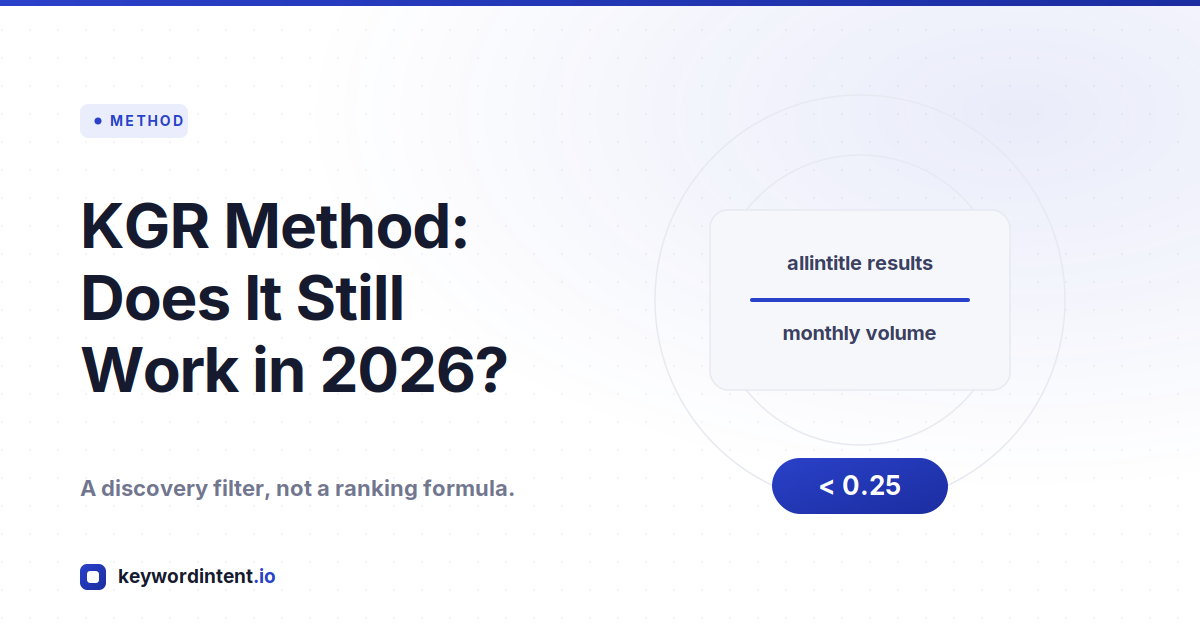
The Keyword Golden Ratio is one division. You take the number of pages that use the exact keyword in their title, the allintitle count, and divide it by the monthly search volume:
KGR = allintitle ÷ monthly search volume
The arithmetic is trivial; the bottleneck is pulling accurate allintitle counts at scale. The KGR Tool handles that part, scoring up to 20 keywords at once so you can spend your time deciding what to do with the numbers rather than collecting them.
Does It Still Work in 2026?
It works best exactly where it always did: new sites and genuinely low-competition terms. A low-competition gap still exists, and landing one is still one of the cheapest ways to earn early traffic before you have any authority or links to lean on.
What it no longer does is feel magical. There was a window where a low ratio plus a passable post was close to a guarantee. That window is closed. You have to play it smarter now, because the ratio gets you considered, not ranked.
What the community keeps saying
- Still a lifesaver for new domains, as long as you build tight topical clusters instead of scattering random posts.
- It usually fails for people who rely on the ratio alone and expect rankings to follow.
- Google is smarter about intent now. A low ratio plus unhelpful content still earns you nothing.
- Best treated as a discovery filter, not a formula. The leverage was always in what you did after the number.
Why People Think KGR Is Dead
Almost everyone who declares KGR dead made the same move: they plugged in a keyword, saw a number under 0.25, published something, and waited for rankings that never came. When the page stalled, the conclusion was that the method is broken.
A perfect KGR under 0.25 that still does not rank is normal, not a contradiction. The ratio only tells you that few pages currently target the exact phrase in their title. It says nothing about whether your page answers the query better than what is already there. Treated as a ranking formula, "KGR" as it is usually described is basically made up. The number was never the source of the wins.
So the useful reframe is this: KGR shows you that competition looks weak. That is a lead, not a verdict. Everything that decides whether you actually rank happens after you read the number.
Clusters and Internal Links Do the Heavy Lifting
The operators still winning with KGR are not publishing a pile of unrelated low-ratio posts. They group those keywords into tight topical clusters built around one buyer problem, then link the pages to each other.
That internal linking is what turns a folder of articles into a topic Google can trust. Relevance and authority flow across the cluster, so the whole subject gains ground rather than one orphaned post fighting alone. Once the cluster is solid, a few quality backlinks pointed at the main page push the entire group further up.
Skip the cluster and even a flawless ratio will not hold. A single low-KGR page with nothing linking to it and nothing around it has no structure to sustain a ranking once anything stronger shows up.
Read the SERP, Not Just the Number
The ratio is the filter. The search results page is the verdict. Before you build anything around a keyword that cleared KGR, open the results and look at what you are up against.
Two questions decide it:
- Are the top results outdated or thin? Old posts, shallow pages, and off-target answers are the openings KGR is pointing you toward.
- Can your page solve the intent better? If you can answer the query more completely than everything on page one, the low ratio is worth acting on.
From a clean ratio to a decision
Zero Volume Is Not Zero Demand
The most common reason people throw away good KGR targets is a volume reading of zero. They assume nobody searches the phrase. Often that is wrong.
Long-tail phrases frequently sit below the threshold a keyword tool can estimate, so the tool reports zero even though real people type the words every week. Trust a low allintitle count even when the volume reads zero. Those near-invisible terms are exactly where a new site finds room, because almost no one is bothering to target them.
Check Commercial Intent Before You Build a Cluster
KGR keywords skew informational. Many of the cleanest ratios you find carry zero commercial intent, which is fine for traffic and useless for revenue. It is easy to build an entire cluster that pulls in visitors who were never going to buy anything.
Decide the job before you commit. If the page exists to grow awareness or feed an audience, low commercial intent is no problem. If it is meant to convert, check that the keyword sits somewhere a buyer actually passes through. Match the keyword to the goal first; build the cluster second.
If You Don't Know the Niche, Research Beats the Ratio
When you are walking into a niche you do not understand, the ratio is no substitute for understanding the customer. The number cannot tell you what people are trying to do or where they get stuck.
So do the unglamorous work. Read the search results themselves, lean on free tools and the Google Ads keyword planner, and map how your buyer moves from researching to deciding. Learning the customer and their buying process surfaces better keyword clusters and sharper questions than any overpriced tool ranking phrases by a single ratio.
A KGR Workflow That Holds Up in 2026
Put the pieces together and the method stops being a lottery ticket and starts being a process.
- Start with a topic, not a keyword. Build a seed list around one buyer problem so everything you find belongs together later.
- Run the list through the KGR Tool. Treat scores under 0.25 as priorities and 0.25 to 1 as maybes worth a second look.
- Open the SERP for each survivor. Outdated or thin top results plus an intent you can serve better is your green light.
- Check commercial intent against your goal, especially if the page needs to convert rather than just attract.
- Group the survivors into one tight cluster and plan the internal links between them before you write a word.
- Publish the cluster, link it internally, then earn a few quality links to the main page to push the whole topic up.
When KGR Still Wins, and When to Skip It
| Situation | What KGR is worth |
|---|---|
| New site, no backlink budget | Use it. The cheapest way to find footholds. |
| Established, high-authority site | Less critical. You can take on tougher terms directly. |
| Top results are outdated or thin | Strong signal. Act on it. |
| Top results are strong and helpful | Skip it. A low ratio will not save you. |
| The page needs to convert | Only after an intent check. |
| Long-tail term with "zero" volume | Often the real opportunity. |
Frequently Asked Questions
Is the KGR method dead in 2026?
No. It still works, mostly for new sites and low-competition terms. What died is the idea that the ratio alone produces rankings. Treat it as a discovery filter, pair it with clustering and internal links, and it still earns early traffic.
What counts as a good KGR score?
Under 0.25 is a great opportunity, 0.25 to 1 is worth considering, and above 1 is too competitive on paper. The thresholds are a filter, not a promise that a passing keyword will rank.
Why isn't my keyword ranking even with a KGR under 0.25?
Usually because the page does not answer the intent better than what already ranks, or it sits alone with no cluster or internal links around it. Read the SERP, make sure your content is the best answer, and build it into a topic rather than publishing it in isolation.
Does KGR work without backlinks?
For a new site building tight clusters, yes, it can earn early rankings before you have links. Adding a few quality backlinks later pushes the cluster further, but the structure comes first.
Should I trust keywords that show zero search volume?
Often, yes. Many long-tail phrases are searched too rarely for a tool to estimate, so they report zero even though real people use them. A low allintitle count on a zero-volume phrase is frequently where a new site finds room.
Is KGR good for affiliate or commercial pages?
Only after an intent check. Many low-ratio keywords are purely informational and bring traffic that never converts. Confirm the term sits where a buyer actually decides before you build a commercial cluster around it.
KGR in 2026 is a filter, not a formula. Use it to find where competition is thin, then win the spot with content that answers the query better, a cluster that gives the topic structure, and internal links that hold it together. Start by scoring a list in the KGR Tool and take only the ones the SERP tells you that you can win.