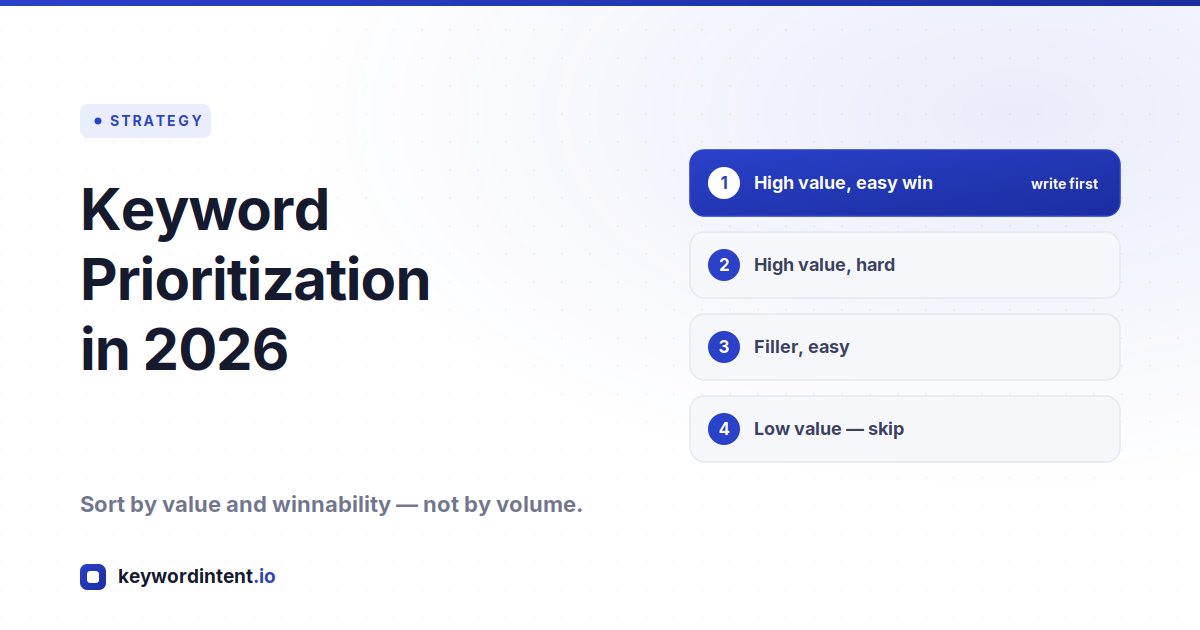
Keyword Prioritization in 2026: How to Decide What to Write First
A keyword list is raw material, not a plan. The hard part of keyword research is not finding terms, it is deciding which ones to write first when you have more than you could ever cover. Most people sort by volume, write the biggest terms, and then wonder why the traffic never turns into anything. The better filter is simple: prioritize by what a keyword is worth to your business and how realistically you can win it, in that order.
Volume tells you how many people search. It does not tell you whether they will become customers, or whether you stand any chance of ranking. A term searched ten thousand times that you cannot rank for and that never converts is worth less than a term searched fifty times that brings the right buyer to a page you can actually win. This piece lays out a prioritization framework you can run on any list, and how to balance the quick wins against the long bets so you are not forced to choose one or the other.
A List Is Not a Plan
Discovery is the easy half. Seed a few terms, expand them, and you have hundreds of candidates inside an afternoon. The list itself decides nothing. Prioritization is the work of choosing the order and, just as important, deciding what to cut. Treat it as a separate chore you do at the very end and you will already have wasted weeks writing the wrong pages.
So make it a filter you apply as you research, not an afterthought. For every keyword that survives, two questions settle its place: what is it worth, and can I win it. The rest of this guide is how to answer each one, then how to combine them into an order you can actually work through.
Start With Business Value, Not Volume
Before traffic, ask what a ranking would be worth. A clean way to do this is to score each keyword for how directly your product or service answers the search, on a scale from zero to three. Most of your effort should go to the twos and threes, and most of the zeros and ones should be dropped unless there is a specific strategic reason to keep one.
| Business value | What it means |
|---|---|
| 3 | Your product is the answer to the search. Target these first. |
| 2 | Your product helps but is not essential. Still worth it. |
| 1 | You can mention your product only in passing. Low priority. |
| 0 | No natural way to connect your product at all. Usually skip. |
A page that ranks but leads nowhere is a vanity metric. It looks like progress in a traffic chart and does nothing for the business. Scoring for value first keeps you from filling a content calendar with terms that will never pay, no matter how much volume they carry.
Judge Traffic Potential, Not Single-Keyword Volume
A page never ranks for just one keyword. Whatever term you target, there are usually many more phrasings that mean the same thing, and a good page ranks for most of them and earns clicks from each. That means the volume on your one target keyword almost always understates the real traffic a page can pull.
So judge the topic, not the phrase. The practical move is to look at how much total traffic the current top-ranking page earns across all its terms, rather than the headline volume of your single keyword. A keyword with modest volume can sit on a high-traffic topic, and that is the one you want. It is also why a low-volume term is so often underrated: the number on the term hides the size of the subject behind it.
Then Ask What It Takes to Win
Value is half the decision. The other half is whether you can rank at all, and a high-value term you have no chance of winning this year is a goal, not a task. Three things tell you how hard a term will be, and none of them is a single difficulty score.
- The results page. Open it. If the top pages are strong, current, and genuinely helpful, it is hard regardless of the score. If there is a thin or dated page you can displace, it is gettable.
- Your own standing. The same term is easy for a site with authority in the topic and hard for a new one. The score cannot see your site, so you have to weigh your relevance yourself.
- The effort it takes. One article, a whole cluster, or links on top. A term that needs a cluster to win is a bigger commitment than one a single page can take.
The keyword difficulty guide covers why the score is a starting filter rather than an answer, and the KGR Tool gives you a fast read on real targeting pressure across a batch of terms.
Value Times Winnability
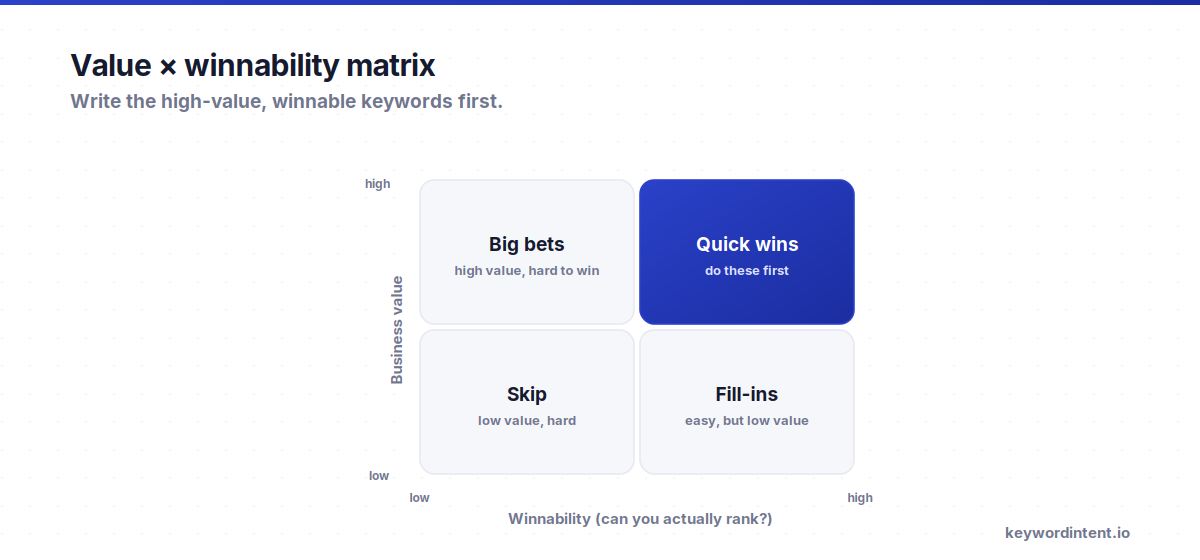
Put the two axes together and every keyword falls into one of four buckets. The order you work them in is the whole point of prioritizing.
| Keyword type | What to do |
|---|---|
| High value, easy to win | Do these first. Quick wins that actually pay. |
| High value, hard to win | The big bets. Plan them and build toward them, do not start here. |
| Low value, easy to win | Fillers. Use sparingly to round out a cluster, never as the main job. |
| Low value, hard to win | Skip. They cost the most and return the least. |
The mistake is to start with the high-value, hard-to-win terms because they are the most exciting. As a new site you cannot win them yet, so you spend months on pages that never rank. Start with the quick wins, build authority, and the hard bets move from impossible to merely difficult.
Balance Short, Medium, and Long-Term
There are two ways to get the balance wrong, and they are mirror images. Chase only low-competition, easy terms and you will get traffic quickly but never rank for anything lucrative, capping how far the site can go. Chase only the big, valuable terms and you will get nothing for a year or more while you wait for authority you have not built yet.
The fix is to run all three horizons at once instead of picking one. Quick wins give you momentum and early traffic now. Mid-term cluster plays, a pillar and its supporting pages, pay off over the next few months. And a small number of long bets, the high-value terms you cannot win yet, get chipped at continuously so that when your authority catches up, the pages are already there. Always have something landing this month and something building for next quarter.
What to Deprioritize or Cut
Prioritizing is as much about removal as ordering. A term comes off the list, or drops to the bottom, when:
- A one-line answer resolves it. If an AI Overview or snippet fully answers the query on the results page, expect the rank to earn no click, and spend the effort elsewhere.
- There is no path to anything you offer. If a visitor has no route from the page to a product, a signup, or a next step, the traffic is decoration.
- It is off-topic for the pillar you are building. Padding a cluster with unrelated terms to hit an article count weakens the topic instead of strengthening it.
- It duplicates a page you already have. If the same results rank for two phrasings, one page covers both and a second only competes with it.
That third point is its own common trap. Setting a fixed number of articles per topic forces filler and dilutes the cluster, which the keywords per pillar guide covers in full. Whether two phrasings need one page or two comes down to the results, a check the search intent guide walks through.
A Prioritization Workflow
Run a finished keyword list through this to turn it into an order of attack.
- Score each keyword for business value on a zero-to-three scale, and drop most of the zeros and ones.
- Estimate real traffic potential from the top-ranking page's whole topic, not your single keyword's volume.
- Read the results page and weigh your own authority to judge winnability and the effort each term takes.
- Sort the survivors into the four buckets and line up the high-value, easy-to-win terms first.
- Pick a few high-value, hard-to-win terms as ongoing long-term goals, and start building the clusters that lead to them.
- Group what is left by intent on the Keyword Grouping Tool so each page targets one job, then schedule the writing.
Frequently Asked Questions
How do I prioritize keywords for SEO?
Score each term by what it is worth to your business and how realistically you can rank for it, not by volume. Do the high-value, easy-to-win terms first, plan the high-value hard ones as long-term goals, and cut the terms that lead nowhere.
Should I target high-volume or low-competition keywords first?
Start with high-value terms you can actually win, which are usually lower competition for a new site. Then balance the rest across horizons, quick wins for momentum now and a few big bets you build toward, rather than going all-in on either.
What is keyword business potential?
A measure of how directly your product or service answers the search, scored zero to three. A three means your product is the answer, a zero means there is no natural way to connect it. Focus on the twos and threes and drop most of the rest.
Is search volume a good way to prioritize keywords?
On its own, no. Volume ignores whether the traffic converts and whether you can rank, and it understates traffic potential because a page ranks for many terms, not one. Use it as an input alongside value and winnability, not as the deciding factor.
How do I balance quick wins and big keywords?
Run both at once. Use quick wins for early traffic and momentum, build mid-term clusters that pay off over months, and keep a few long bets moving in the background so the pages are ready when your authority catches up. Always have something landing and something building.
When should I skip a keyword entirely?
When a one-line AI Overview answers it, when there is no path from the visitor to anything you offer, when it is off-topic for the pillar you are building, or when it just duplicates a page you already have with the same results ranking.
Prioritization is where keyword research turns into results. Rank every candidate by what it is worth to your business and how realistically you can win it, do the high-value quick wins first, and keep a few long bets moving in the background so you are always building toward the terms that matter most. Score your list for value, read the results page for winnability with help from the KGR Tool, and group the survivors on the Keyword Grouping Tool so each page you commit to is one you can rank and one that pays.