Keyword Density and Stuffing in 2026: Does Repeating a Keyword Help You Rank?
Short answer: no. Repeating a keyword more times does not move you up, and past a certain point it actively drags you down. If you have twenty image alt tags already saying “chrome hearts jeans” and you push it to sixty, you will not rank higher for it. You will look like you are trying to game the system, which is the one thing Google is very good at catching.
The belief that more mentions means higher rankings is a holdover from search engines that no longer exist. Modern search reads meaning, not repetition. This piece explains why the old instinct feels right, why it stopped working, and what to do instead of counting words.
More Mentions Will Not Move You Up
The question comes up constantly, usually in some version of: if I add more of the keyword to my titles, alt text, meta descriptions, and body, will I rank higher for it? The honest answer is that you are already past the useful point. Twenty alt tags carrying the exact same phrase is not optimization, it is a signal of stuffing, and adding forty more makes it worse.
A keyword needs to be present so the page qualifies for the term. Present means it appears naturally where it belongs. Beyond that, frequency is not a lever you can pull for position. The page that wins does so by answering the query better, not by saying the query more often.
Why the Idea Feels True
The instinct is not stupid. There was a long stretch where it was simply how search worked. Early engines really did lean on keyword density, the raw count of how often a term appeared on a page, to decide what that page was about. If you used the phrase more, you ranked for it more. The logic was crude but real, and a generation of advice was built on it.
That advice outlived the technology. People still repeat rules of thumb like keeping a keyword at a few percent of the text, or working it in seven times per eight hundred words. Those numbers describe a world that is gone. They feel precise, which is exactly why they are so sticky, but precision about the wrong thing does not help you rank.
How Search Stopped Counting Words
Search got dramatically better at understanding language. Where an old engine matched strings of characters, modern search reads the page the way a person would, weighing the topic, the context, and how completely the content answers the question. Counting one phrase is a tiny, easily-faked signal, so its influence shrank to almost nothing.
What replaced it is the concept of entities and related meaning. Instead of asking “how many times does this page say the keyword,” the engine asks “does this page talk about the things you would expect from a page that genuinely covers this topic?” A real page about keyword density will naturally mention rankings, search results, indexing, and optimization. The presence of that related vocabulary tells the engine the page is the real thing, far more convincingly than repeating two words ever could.
So the exact-match phrase still has to be on the page to confirm relevance. It just stopped being something you can dial up for position. Once it is present, more of it adds nothing and risks a penalty.
There Is No Magic Density Number
There is no universal percentage that beats other pages. No three percent target, no ideal count, no density figure you can hit to win. Anyone selling you a specific number is selling you a relic. The only thing close to a useful rule is that your main phrase tends to be the most-used relevant phrase on the page, and that happens by itself when you write tightly about one topic without wandering.
Notice the direction of that rule. You do not aim for a density and write to fill it. You write a focused page for a human, and a sensible density falls out as a byproduct. Chasing a number is how you end up with stilted, repetitive copy that reads worse and ranks no better.
Why Stuffing Actively Backfires
Overdoing it is not neutral. There is a point where more becomes too much, and if you are already there, the last thing you want is more. Keyword stuffing makes content awkward for readers, which raises bounce and weakens the page, and it can trip the engine's spam detection directly. The downside is real and the upside is zero.
What the community keeps repeating
- No, that is not how it works anymore. You are more likely to get penalized for stuffing than rewarded for repetition.
- Tactics like cramming a phrase into everything worked in the early 2000s and stopped working a long time ago.
- Serve the intent and earn links to the page. That is what moves position, not the count of a phrase.
- If a term already appears many times, adding related terms helps and adding more of the same hurts.
Related Terms Beat Repetition
The move that actually helps is the opposite of stuffing. Instead of repeating the exact phrase, broaden the vocabulary around it. If the page is about jeans, the engine expects to see denim, fit, sizing, styles, and the brands and occasions that go with them. That related language is what establishes the page as a complete answer.
This is the same machinery that builds topical authority. A page reads as expert when it covers the concepts a real expert would cover, not when it hammers one phrase. So when you feel the urge to add the keyword a fortieth time, add a related subtopic instead. It does more for relevance and it does not risk a penalty.
Where the Keyword Actually Belongs
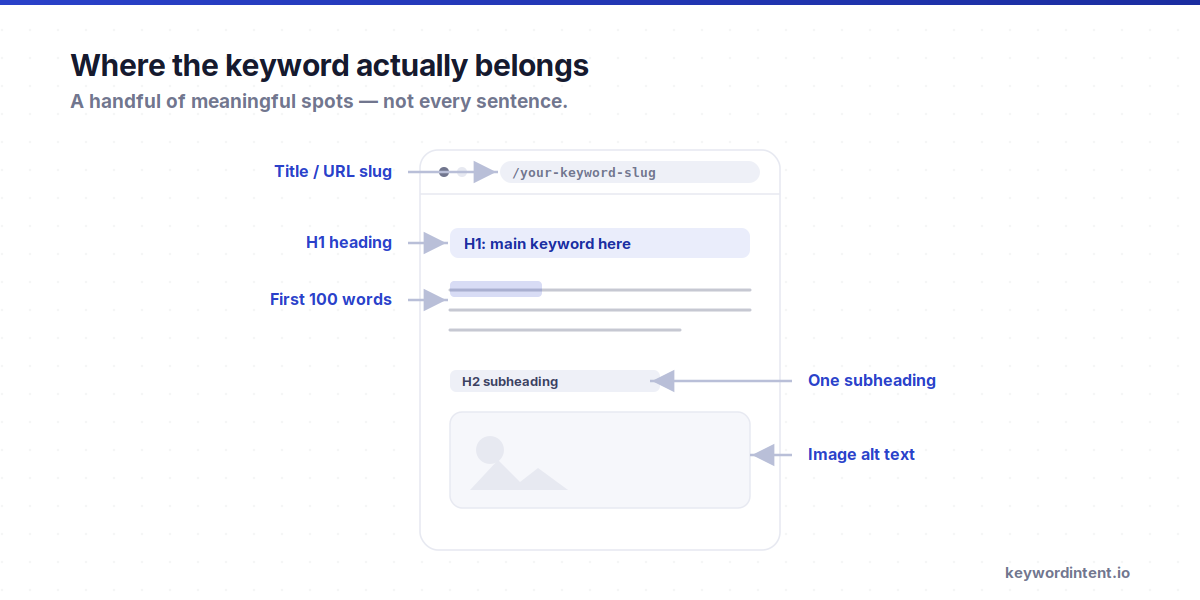
Placement matters more than count. A keyword in the right few spots does more than the same keyword sprayed across the page. Put it where it confirms what the page is about, then stop.
The spots that count
That is the whole checklist. Hit those spots once each and the page qualifies for the term. Everything after that should be written for the reader, with related terms filling in naturally as you cover the topic properly.
Internal Links and Anchor Text Do More
If you want to spend energy on something that actually moves rankings, spend it on links rather than repetition. Pointing your own related pages at the target page, using descriptive anchor text, tells the engine what that page is about with far more weight than another on-page mention. A page about one product line linking to another with a clear, relevant phrase is a genuine signal. Saying the same phrase one more time in your own copy is not.
The same care applies to links from other sites. Identical anchor text repeated over and over can look orchestrated, so vary it where you have any say. Build the internal structure first with the Keyword Grouping Tool so related pages cluster and link to each other, then let a few quality external links point at the page you most want to rank. That structure outperforms any amount of keyword repetition.
So How Many Times Should You Use It?
Enough to be clearly about the topic, and not one time more for the sake of it. In practice that means the placements above, the title, a heading or two, the opening, and then wherever the natural flow of good writing brings it up. If you are counting, you are already optimizing for the wrong thing.
The reliable test is to read the page out loud. If the phrase sounds forced or you notice it repeating, you have too much. If it reads like a person explaining the topic to another person, you are in the right range, whatever the number happens to be. Write for the human, confirm the term is present, and move on to making the content the best answer on the page.
Healthy Optimization vs Stuffing
| The move | Does it help? |
|---|---|
| Keyword in the title, once, near the front | Yes. The strongest on-page spot. |
| Repeating the exact phrase dozens of times | No. Risks a stuffing penalty for zero gain. |
| Adding related and semantic terms | Yes. Builds real relevance. |
| The same phrase in every image alt tag | No. Reads as manipulation, not description. |
| Internal links with descriptive anchor text | Yes. A genuine relevance signal. |
| Hitting a fixed density percentage | No. There is no magic number to hit. |
Frequently Asked Questions
Does using a keyword more times help me rank higher?
No. Once the phrase is present in the right places, adding more does nothing for position and can trigger a stuffing penalty. Rankings come from answering the query better, earning links, and covering the topic with related terms, not from repetition.
What is the ideal keyword density?
There is no ideal number. Old advice about a few percent or a set count describes search engines that no longer matter. Write a focused page for a reader and a natural density takes care of itself. Aim for a number and you usually end up with worse copy that ranks no better.
Will keyword stuffing get me penalized?
It can. Stuffing makes content awkward, raises bounce, and can trip spam detection directly. The risk is real and there is no upside, so there is no reason to do it. Use the phrase where it belongs and stop.
How many times should a keyword appear on a page?
Enough to be clearly on topic and no more. In practice that is the title, a heading or two, the opening lines, and wherever natural writing brings it up. If you are counting occurrences, you are optimizing for the wrong signal.
What should I add instead of repeating the keyword?
Related and semantic terms, and more complete coverage of the topic. A page about a subject should mention the concepts a real expert would mention. That related vocabulary builds relevance far better than saying the exact phrase again.
Do keywords in alt text help rankings?
Alt text should describe the image for accessibility first. If your keyword genuinely describes an image, using it once is fine. Putting the same phrase in every alt tag is a stuffing signal, not an optimization.
Repetition is a strategy from a search era that ended years ago. Put the keyword where it confirms the topic, then stop counting and start covering: related terms, complete answers, and internal links with clear anchor text. Group your pages so they reinforce each other in the Keyword Grouping Tool, and let search intent decide what each page is for. That beats any density target you could aim at.