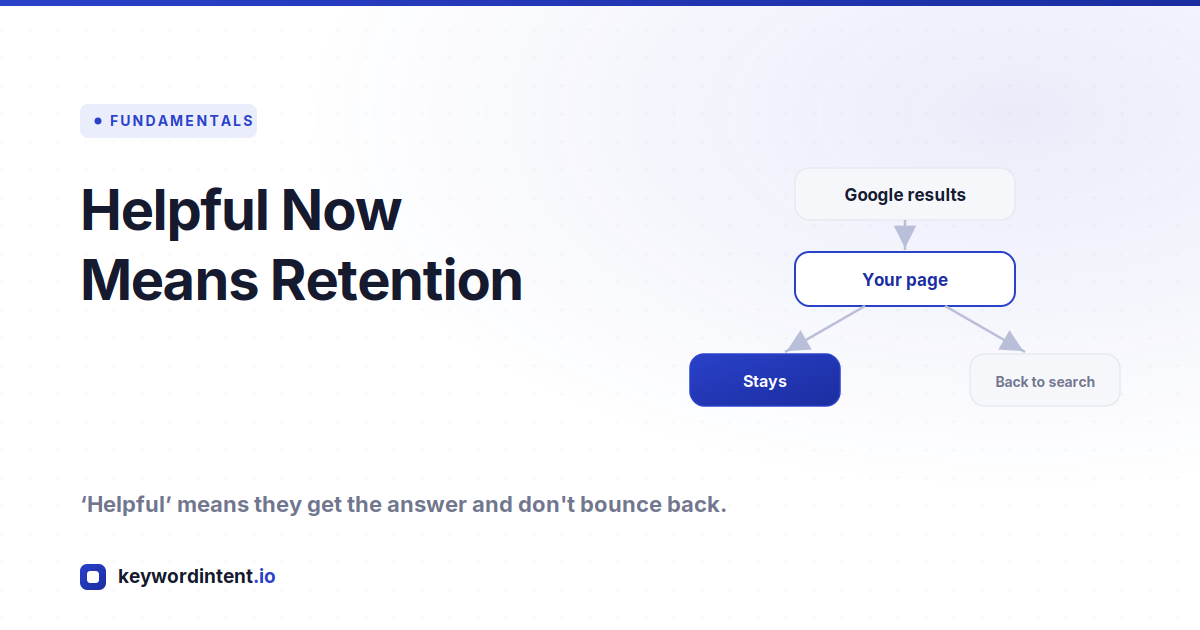
The Latest Google Update: Why “Helpful Content” Now Means Retention in 2026
After the latest round of updates, a lot of people are watching rankings move in ways the old playbook does not explain. AI-spam content dropping hard. Reddit and forums surfacing everywhere. Small niche sites beating big high-authority ones. Backlinks mattering, but less than they used to. The common thread everyone keeps naming is engagement, retention, helpfulness.
The problem is that most people misread what those words mean, and chase the wrong fix. This piece walks through what actually shifted, what the retention signal really is (it is not what you think), and the one honest caveat about how much of this Google confirms. Then it connects all of it back to the keywords you choose in the first place.
What People Are Actually Seeing
Strip the panic out of the threads and a consistent picture remains. These are the patterns showing up across niches after the update.
The recurring pattern
None of this is a new algorithm doing something exotic. It is the search engine getting better at the thing it always claimed to reward: sending people to the page that actually helps them. The updates mostly close the gap between what ranked and what deserved to.
The Word Everyone Misreads: “Helpful”
People treat “helpful content” as a vague slogan and then keep optimizing the same things: more words, more keywords, more links. But the word is literal. Helpful content is content that actually solves the problem the searcher arrived with. The update is the system getting sharper at detecting pages that do not, and demoting them.
That reframes the whole job. The question is no longer “how do I signal quality to Google?” It is “does this page genuinely do what the person needed, better than the alternatives?” If the answer is yes, the modern signals tend to line up behind you. If it is no, no amount of optimization on top rescues it for long. You are not trying to look worth ranking. You are trying to be worth ranking.
Retention Is Not Time on Page
Here is the part almost everyone gets wrong. When people say retention signals matter now, they picture time on page and assume the goal is to keep visitors reading longer. That is the wrong target. A page can hold someone for four minutes and still fail, if at the end they go back to the results and click a competitor.
The signal that matters is the opposite of dwell time. It is whether a searcher lands on your page, gets what they needed, and stops, versus bouncing back to the results to try the next link. Fat time on page means nothing if it ends in a return trip to the SERP. The thing to fix is never the word count. It is whatever is sending people back to keep looking.
Two pages, same time on page
One honest caveat, because it matters. Google has long said it does not use clicks or this kind of back-to-results behavior as a direct ranking factor, and the exact mechanism is debated among people who do this for a living. Treat “retention” as a practical model, not a confirmed dial you are tuning. The useful part is that it points you at the right goal anyway: satisfy the intent so completely that no one needs to look further. We dig into that contested ground more in does search intent actually matter.
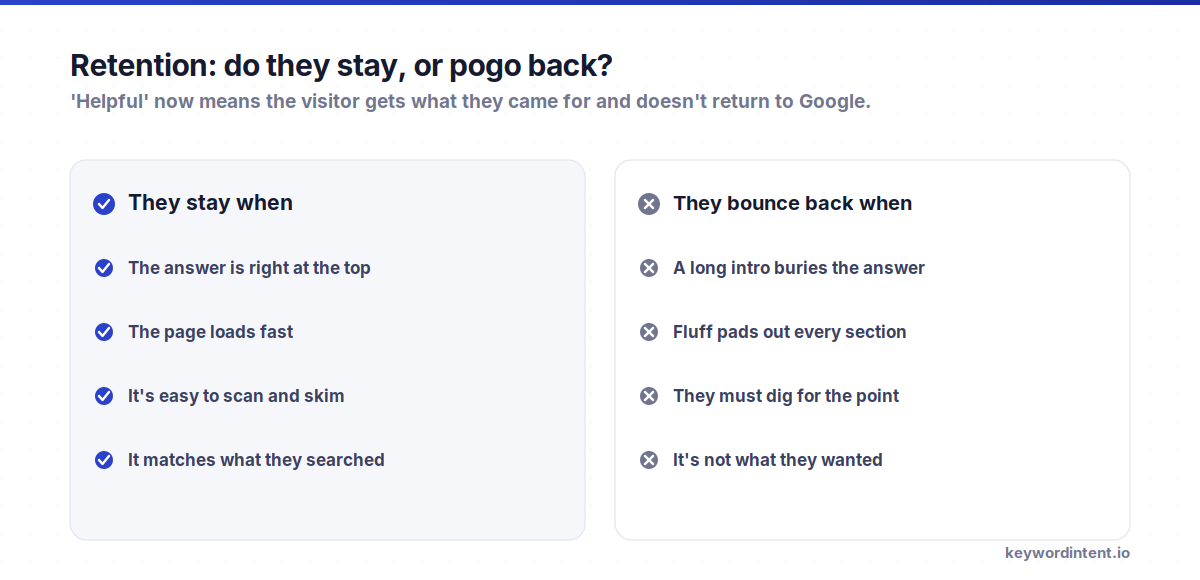
Cut the Fluff, Answer Faster
Follow the retention idea to its conclusion and you land somewhere counterintuitive: shorter, sharper pages often win. The instinct to pad an article to two thousand words for “depth” is exactly what sends people back to the results, because they have to dig for the answer you buried under an introduction nobody asked for.
Operators keep reporting the same result. Cut a bloated post down, put the answer in the intro, and rankings improve, because the page finally does the one job the query needed. Length was never the signal. Satisfaction was. This is the same lesson as keyword density and stuffing: doing more of a thing, more words, more repetition, is not the same as doing the thing well. Answer the question, support it properly, and stop.
Niche Authority Beats a High DA Score
One of the clearest shifts is that a small site owning a narrow topic now routinely beats a big generalist with a higher authority score. A site at modest authority that covers one subject completely can outrank a large, high-authority site that touches the subject in passing. Focus is winning over raw size.
Part of why this confuses people is that they are watching the wrong number. Domain authority is a third-party estimate invented by tool makers, not a metric the search engine uses. A high score never guaranteed rankings, and chasing it was always a proxy for the real thing: being the most relevant, most complete answer on a topic. That relevance is what topical focus builds. If you want the mechanics, see what keyword difficulty really measures on third-party scores, and topical authority on how depth on one subject actually compounds.
Why Reddit Is Everywhere (and What It Means)
The most visible change is forums, Reddit especially, ranking for queries they never used to. The reasonable read is that the search engine is leaning toward real, first-hand, human answers for questions where people clearly want lived experience over a polished marketing page. When you want to know if a product actually works, a genuine thread often beats a brand's own copy.
Some of those forum results ranking at the top are years old with a handful of upvotes. It works for them, but it is the search engine borrowing credibility it could not build on its own pages.
That critique is worth taking seriously, and it points to the real lesson. The takeaway is not “go spam Reddit,” which backfires fast. It is that first-hand, specific, genuinely useful content is what is being rewarded, whether it lives on a forum or on your site. You can win the same way the threads do: write from real experience, answer the actual question, and be specific enough that no generic page can replace you. The Reddit Topic Hunter is useful here for a different reason, finding the real discussions and questions people are having, so you know what first-hand answers your audience is actually looking for.
What This Means for the Keywords You Pick
Every signal in this update points back to one upstream decision: the keywords you choose to target. If the winning pages are the ones that satisfy intent so well nobody looks further, then the question to ask before you write is not “can I rank for this?” It is “can I satisfy this query better than what already ranks?”
That changes how you filter a keyword list. A term where the top results are thin or generic is an opening, because you can genuinely do better. A term where strong, first-hand pages already own the intent is one to skip for now, no matter how good the volume looks, because you will not out-satisfy them yet. Reading the SERP before you commit, covered in matching keywords to intent and keyword prioritization, is how you make that call. Expanding a seed on the keyword tool gives you the candidates. Reading what already ranks tells you which ones you can actually win.
Frequently Asked Questions
Does dwell time or time on page affect rankings?
Not the way people assume. Google has long said it does not use clicks or time on page as a direct ranking factor, and the mechanism is debated. The useful model is satisfaction: a page that fully answers the query so the searcher does not return to the results. Optimize for that, not for a stopwatch.
Should I make my content longer to rank?
No. Length is not a ranking signal, and padding often hurts by burying the answer and sending people back to the results. Make the page as long as the query needs and no longer. Answer the main question early, support it well, and stop.
Does domain authority still matter?
Domain authority is a third-party estimate, not a Google metric, so it never directly mattered. What it tries to approximate, credibility and relevance, still matters. A focused site with real topical depth can and does beat a higher-scored generalist.
Should I post on Reddit to rank?
Not as an SEO tactic. Self-promotional posts get removed and can backfire. The lesson from Reddit ranking is about content type, not placement: first-hand, specific, genuinely useful answers win. Write that kind of content on your own site, and use communities to understand what people actually ask.
Is AI content penalized now?
Not for being AI-written specifically. Thin, generic, unhelpful content is what loses, and AI makes that kind of content easy to mass-produce. AI used to draft and structure genuinely useful pages, with real experience added on top, is fine. The filter is on quality and helpfulness, not the tool.
The update did not rewrite the rules, it enforced the one that was always there: help the searcher or lose the spot. Retention is a useful way to picture it, but the real target is satisfying intent so completely that no one needs the next result. That starts before you write, with the keywords you choose. Expand a seed on the keyword tool, read what already ranks, and target the queries where you can genuinely be the best answer, not just another one.