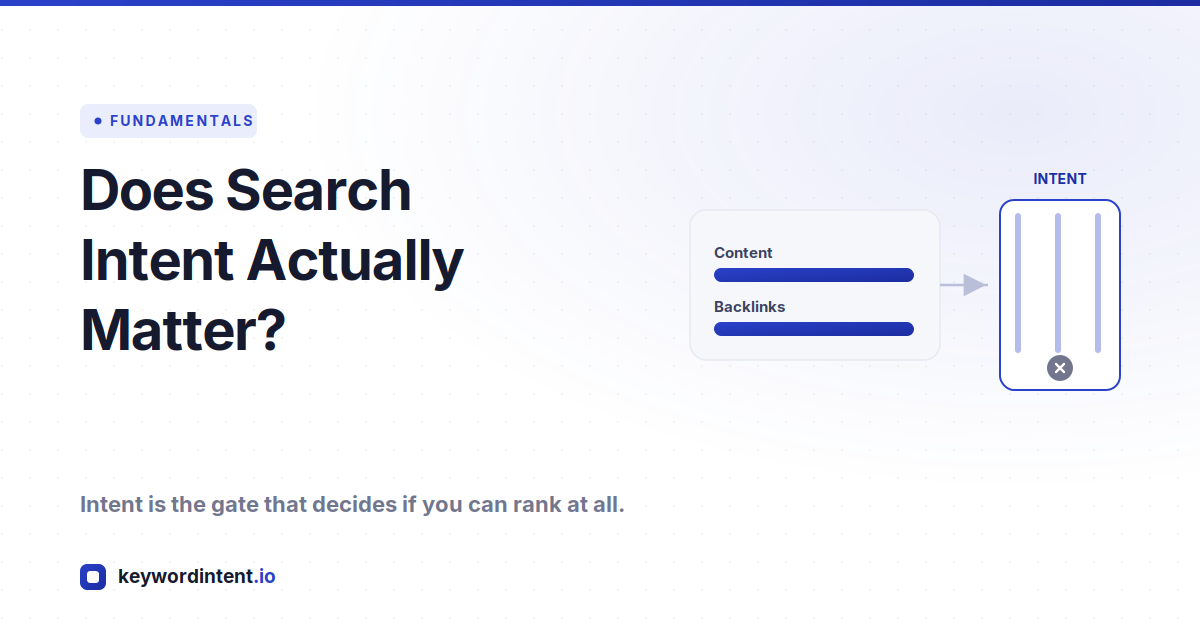
Does Search Intent Actually Matter, or Is Content and Backlinks Enough in 2026?
There are two ways people wave search intent off, and they sound opposite. One is the manager who says intent and user behavior do not matter, that all that counts is quality content and backlinks. The other is the veteran who says intent is a buzzword for something SEOs have always done. Both have a real point buried inside them. Both also miss the same thing.
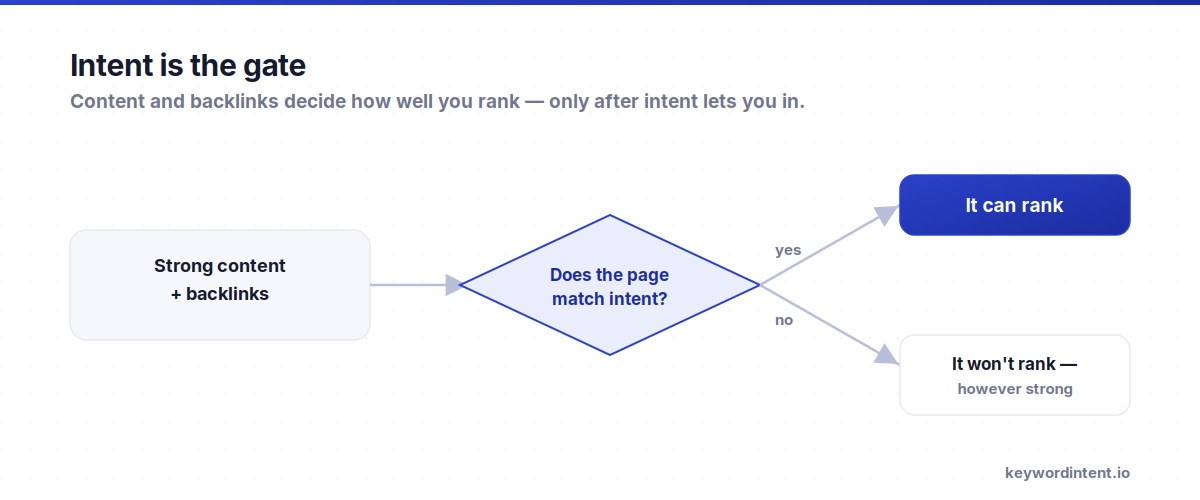
Intent is not a soft ranking signal you feed the algorithm, so the first camp is right to be suspicious of it as a metric. And the practice is genuinely old, so the second camp is right about the history. What both skip is that intent is not a signal at all. It is the filter that decides whether your page is even allowed to rank, before content quality or backlinks get a vote.
Intent Matters, but Not the Way Either Side Thinks
Here is the honest version. Search intent is not something you optimize the way you optimize a title tag or chase the way you chase links. There is no intent score to raise. What intent does is set the terms of the contest. Google has already decided what kind of page a given query deserves, and it shows you that decision on the results page. If your page is the wrong kind, it does not lose the ranking race, it never qualifies for it.
So the manager who wants to pour everything into content and backlinks is not wrong that those matter. He is wrong about the order. Get the page type wrong and the best content and the strongest backlinks in your niche cannot rescue it, because Google is not looking for a great article on a query where it has decided people want to buy.
Give the Skeptics What They Are Owed
It is worth conceding the parts that are true, because they are the parts that make intent get dismissed by serious people, not beginners. The manager is right that there is no such thing as generic “SEO optimized content” measured by word count. Google's own guidance is plain that word count is not a ranking factor, and a two thousand word version of a page does not beat a five hundred word version for being longer. Padding a page to hit a length is a habit that outlived the era it made sense in.
He is also right, as we will get to, that the user-behavior folklore is shakier than the people selling it admit. And the veteran is right that none of the intent vocabulary is new. Informational, navigational, and transactional were named categories last decade, and reading the results page to see what Google rewards is exactly what any competent SEO has done for years. Concede all of that cleanly. It does not weaken the case for intent. It just clears away the strawman version of it.
The User-Behavior Confusion
Most of the argument about intent is really an argument about user behavior, and the two get tangled. So separate them. The question “does Google measure how people behave on my page” is a different question from “does matching intent matter,” and conflating them is what makes the whole topic feel like guesswork.
On the behavior side, the skeptics have the stronger hand than they are usually given credit for. Google has said it does not use your analytics data, so the time-on-page and bounce-rate numbers in your dashboard are not ranking inputs. Dwell time as a direct factor is contested at best, and it is easy to see why it would be unreliable: a visitor who scans a page in fifteen seconds and then converts is a success, not a failure, so punishing short visits would be self-defeating. The thing Google can actually see is how people interact with its own results page, which is not the same as what happens on your site and is not something you read off your own charts.
Notice that none of that settles the intent question, because intent does not matter as a behavior signal. Whether or not Google weighs any engagement metric, matching intent still matters, for a reason that has nothing to do with dwell time and everything to do with what is allowed on the results page in the first place.
Why Intent Decides Eligibility, Not Ranking
The results page for any keyword is already sorted by intent. Google spent years learning what kind of answer each query wants, and page one is the published result of that learning. Open the results for a term and the pattern is right there. If the top ten are product listings and buying guides, Google has ruled the intent commercial. If they are all how-to articles, it has ruled it informational.
That ruling is a gate, not a scorecard. If Google decided a query wants product pages, your blog post is not ranking poorly for it, it is not eligible for it, no matter how thorough the writing or how many links point at it. Backlinks and content quality decide who wins among the pages of the right type. Intent decides whether you are a page of the right type at all. That is the piece both the “just content and backlinks” camp and the “it is only a buzzword” camp walk straight past.
What this looks like in the results
- A query where every top result is a service or product page will not rank an article, however good, because the intent gate is closed to that format.
- A query where every top result is a guide will not rank a bare sales page, because the gate is closed the other way.
- A mixed results page is Google telling you the intent is split, which is a warning to pick the slice you can actually serve.
- Getting the format right is the price of entry. Content and links are how you compete once you are through the door.
The 3,000-Word Disclaimer Page
Here is the mistake this argument produces in the wild. A manager who believes every page needs optimized content and a keyword target starts putting two or three thousand words on a disclaimer page, or loads a contact page with a transactional keyword and an essay to match. The logic is that more content and more keywords must mean more ranking, everywhere, on every page.
It does not, for two reasons at once. The keyword's intent and the page's job do not match, so the content cannot rank for the term regardless of length. And the essay clutters a page whose only purpose is to serve people who already decided, making it worse at the one thing it exists to do. A disclaimer page has a job. A contact page has a job. Force a ranking keyword onto either and you get a page that is bad at its own role and still invisible for the keyword. One page, one job, is not a slogan, it is what keeps you from doing this.
Content and Backlinks Still Matter, Just Later
Do not read any of this as a case against content quality or links. They matter enormously. They are simply downstream of intent, not a substitute for it. Once you are one of the right-type pages competing for a query, the depth and usefulness of your content and the authority pointing at it are exactly what decide whether you win. Intent gets you into the race. Content and links win it.
The clean way to hold both ideas is that intent is necessary and not sufficient. You cannot skip it and win on content, and you cannot skip content and win on intent alone. Backlinks in particular remain one of the few levers with a real, direct effect, which is why they get so much attention. If you want the honest picture of how much weight a difficulty score or a link profile actually carries, our piece on keyword difficulty pulls that apart. The point here is only that all of it operates after the intent gate, never instead of it.
So Is It Just a Buzzword?
The veteran deserves a straight answer, not a defensive one. Yes, the practice is old. Classifying queries by intent and reading the results page to see what Google rewards is what good SEOs were doing long before anyone packaged it and sold it back to the industry. If that is the complaint, it is a fair one, and pretending intent is a 2024 invention only proves the skeptic's point.
Two things changed, though, and they are what keep it from being empty rebranding. The results page is far more segmented by intent than it used to be. Between shopping units, local packs, question boxes, and generated answers, a query's intent is now enforced more strictly and a mismatch is more fatal than it was a decade ago. And naming the instinct made it teachable. The senior SEO who reads a SERP by feel built that feel over years. Giving the skill a name and a method is how someone without those years learns to do it on purpose. A buzzword for a real discipline, and one that got sharper, not softer, is still worth using.
What the Honest Position Actually Is
Put the pieces together and the defensible stance is narrower and more useful than either slogan. It is not “intent is everything” and it is not “intent does not matter.”
| The claim | The honest verdict |
|---|---|
| Word count and length rank you | False. Length is not a factor. |
| Your analytics engagement is a ranking input | No. Google says it does not use your analytics. |
| Intent is a new concept from recent years | No. The practice is old. |
| Matching intent decides if you can rank | Yes. It is the eligibility gate. |
| Content and backlinks decide who wins | Yes, among the right-type pages. |
If your pages are not ranking, the first thing to check is not whether the content is long enough or whether you need more links. It is whether the page type matches what the results are already showing for the keyword. That check costs a few minutes and it is the one the two loudest camps both forget to run. The mechanics of running it are in our guide to matching keywords to intent and the right page.
Frequently Asked Questions
Is search intent a ranking factor?
Not in the sense of a score you raise. It is better understood as an eligibility gate. Google decides what kind of page a query wants and shows that on the results page, and a page of the wrong type does not qualify to rank no matter how good it is. Content and links decide the contest after that gate, not before it.
Does Google use time on page or bounce rate to rank?
Google has said it does not use your analytics data for ranking, so the numbers in your dashboard are not direct inputs, and dwell time as a ranking factor is contested. What Google can see is interaction with its own results page, which is different from what happens on your site. Either way, intent matters for eligibility, not as a behavior signal.
My manager says only content and backlinks matter. Is he wrong?
He is half right. Content and backlinks matter a great deal, but they operate after intent, not instead of it. If the page type does not match what the results already show for the keyword, the best content and strongest links will not make it rank, because it never qualifies in the first place.
Do I need 2,000 words to rank a page?
No. Word count is not a ranking factor, and a longer page does not beat a shorter one for being longer. Match the format the results reward, answer the query as completely as it needs, and stop there. Padding a page to a length target, or putting an essay on a disclaimer or contact page, helps nothing.
Is search intent just a rebranded buzzword?
The practice is old, yes, and pretending otherwise is fair to mock. But the results page is far more segmented by intent than it used to be, so a mismatch is more costly now, and naming the skill made it teachable to people who never built the instinct by feel. It is a label for a real discipline that got sharper over time.
How do I check if intent is my ranking problem?
Open the results for the keyword and compare the format that ranks to the page you built. If everything ranking is a product page and you wrote an article, or the reverse, intent is your problem, and no amount of extra content or links fixes a format mismatch. Rebuild the page as the type the results reward.
The two camps are arguing about the wrong thing. Intent is not a soft signal to optimize and it is not a fad to dismiss. It is the gate that decides whether your page can rank at all, and content and backlinks are how you compete once you are through it. Check the format before you check anything else, then use the intent mapping guide to send each keyword to the page built to serve it.