Citations vs Backlinks: How Off-Page SEO Changed for AI Search in 2026
A growing share of searches never reaches a results page anymore. People ask ChatGPT, Perplexity, or the AI summary at the top of Google, read the answer, and stop. That changes the off-page question. It is no longer only “did a credible site link to me,” it is “did the model choose me as a source, and how did it describe me?”
This is the part of off-page SEO people are calling GEO or answer-engine optimization, and it is surrounded by more confidence than the evidence supports. So this piece splits it cleanly: what genuinely holds up, what is unverified hype, and the few things you can actually do that are worth the effort either way.
The Question Changed, Not Just the Channel
Classic off-page SEO is about earning links and mentions that tell a search engine you are credible, so your page ranks and gets clicked. AI answer engines add a step. They read across many sources, synthesize an answer, and often name a handful of them. To show up, your page or your brand has to be one of the sources the model reaches for.
The uncomfortable part is that these engines lean heavily on third-party sources, not just your own site. When someone asks an AI tool for the best option in your category, it frequently pulls from reviews, roundups, news, and community threads before it pulls from you. What those sources say about you shapes the answer, and you do not write those sources. That is the shift: less control, and a lot more weight on how the rest of the web describes you.
A Citation Is Not the Same as a Backlink
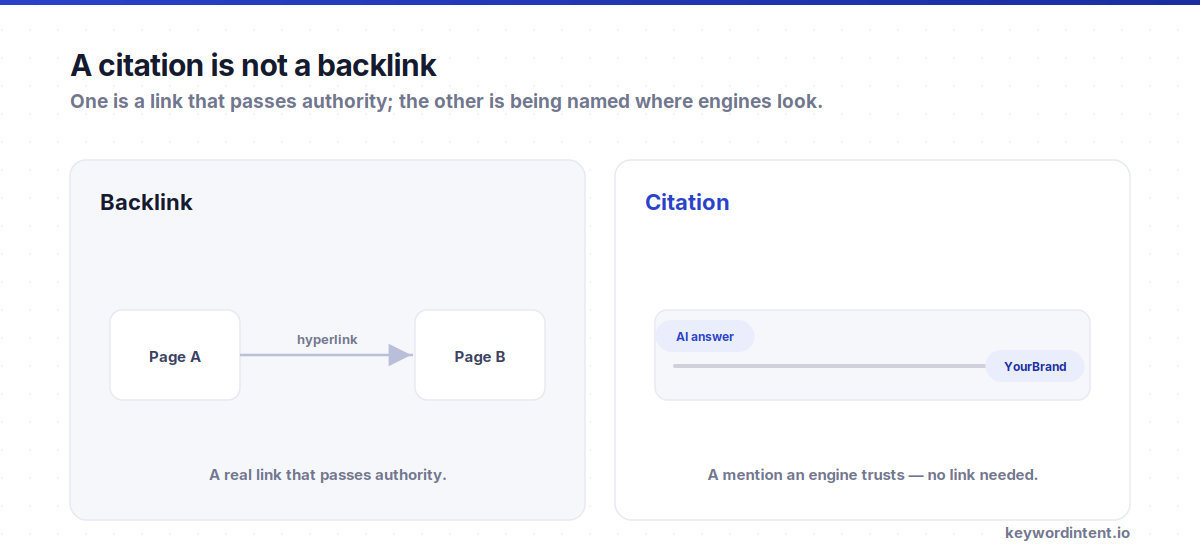
The two overlap, which is why people conflate them, but they are judged differently. A backlink is a hyperlink that passes signals to a crawler. A citation is a model choosing your content as a basis for an answer, and sometimes naming you as the source. The same mention can be both, one, or neither.
Where they diverge
So the two are not rivals. They share a source. Earn genuine mentions on trusted, relevant sites and you tend to help both your rankings and your odds of being cited. The difference is mostly in how each system reads the mention once it exists.
What Is Known, and What Is Hype
This is where you should be careful, because the space is full of precise claims built on thin data. A lot of what circulates is one person's test presented as a law. It is worth separating the two so you do not chase invented metrics.
| Reasonably established | Unverified or overstated |
|---|---|
| Answers draw on many third-party sources | Exact “sentiment scores” the engines supposedly compute for each brand. |
| Being absent from those sources makes you invisible in answers | Precise win rates like a brand ranking higher a specific percentage of the time. |
| How sources describe you shapes how the answer describes you | Fixed per-engine “requirements,” as if each tool needs one named source type. |
You will see community experiments claiming, for example, that qualifying language in your mentions (“great, but expensive”) lowers how often you get recommended, complete with tidy percentages. The direction is plausible: models read the words around your name, so hedged praise probably does read differently than clean praise. The specific numbers are not something you should treat as fact. Take the intuition, leave the decimal points.
The One Thing That Carries Over
Strip away the hype and a single principle survives, and it is the same one that always governed off-page SEO. You control what you say about yourself. You do not control what others say about you, and the systems that decide your visibility trust the second far more than the first.
The pages you write are your claim. The sources that mention you are the evidence. AI answers, like search rankings, weigh the evidence more heavily than the claim.
That is why a perfectly optimized site with no external mentions tends to stay invisible in AI answers, while a site with decent content and a handful of confident, credible mentions keeps showing up. The lever is not your own copy. It is what the trusted parts of the web say when your name comes up.
First, See What the Engines Already Say
Before you try to change anything, find out where you stand, because this part is actually measurable in a way most of GEO is not. Take your most important questions, the ones a potential customer would ask, and put them to the AI tools your audience uses. Read the answers, and watch two things: whether you show up at all, and which sources the model leans on when it responds.
Those sources are your real target list. If a tool keeps citing three review sites and two community threads for your category, those five places are where being present and well-described matters most, far more than any generic link. And if you are missing from the answer entirely, that absence is the problem to solve, not your on-page copy.
Two things to note when you check
Do this across your handful of highest-value questions and you replace guesswork with a concrete list: the exact sources shaping how AI describes your category, ranked by how often they come up. That is a far better starting point than optimizing for metrics no one can verify.
How to Actually Improve Your Odds
You cannot force a model to cite you, but you can make yourself a better candidate. None of this is exotic. It is durable work that also helps classic SEO, which is exactly why it is worth doing under uncertainty.
- Find the exact questions these engines answer in your niche. Mine real phrasing from autocomplete, People Also Ask, and community threads, so you are targeting the way people actually ask, not how you assume they do.
- Earn mentions in the sources from your diagnosis above, the ones the AI already cites for your key questions. Being present and well-described on those exact sites is what moves the answer.
- Make your own pages easy to quote. Answer the question directly near the top, use clear headings, define terms plainly, and add a short FAQ. Models lift clean, self-contained answers more readily than buried ones.
- Keep your facts consistent across the web. When your name, category, and core claims match everywhere you appear, you read as a coherent entity, which helps both search and answer engines represent you correctly.
Notice that every step pays off whether or not the GEO theories hold. You are earning real mentions, targeting real questions, and writing clearer pages. That is the right kind of bet in an area still this unsettled.
Keyword Research Sits Upstream of All of It
You cannot earn a citation for a question nobody asks. Before any of the off-page work, you need to know which questions in your space carry real demand and which ones the answer engines are actually fielding. That is keyword and question research, and it is the input that aims everything downstream.
Expanding a seed on the keyword tool surfaces the questions and comparisons people search, and the Reddit Topic Hunter pulls the real, first-hand discussions that both people and models draw on. If you want the full source-by-source approach to finding those questions without paying for tools, that is the whole point of keyword research without paid tools.
Get that upstream step right and the rest has a target. Earn mentions around the questions that matter, write pages clean enough to quote, and you give yourself a real shot at showing up wherever the answer gets served, a results page or an AI reply.
Frequently Asked Questions
Is GEO just off-page SEO with a new name?
Largely, yes. Getting cited by AI answer engines is mostly about earning mentions on trusted sources, which is what off-page SEO always was. The tactics are close cousins. What differs is that the engine reads the surrounding text to build an answer, so context and clarity matter even more than the raw link.
Do backlinks still matter for AI search?
Indirectly. Links help you rank and get discovered, and the sites that earn links are often the same ones AI engines trust. But a model can cite a mention that never linked to you, so think in terms of being mentioned in context, not just acquiring links.
Can I control how AI describes my brand?
Not directly, and that is the core lesson. You influence it by shaping what credible third-party sources say, keeping your facts consistent across the web, and writing clear pages of your own. You cannot edit the model's summary the way you edit your homepage.
Are the citation studies with exact percentages reliable?
Treat the direction as interesting and the numbers as unproven. Many are single, small tests presented as universal rules. The reasonable takeaways, that third-party mentions matter and that how you are described affects the answer, hold up. The precise figures do not.
What is the single best thing to do right now?
Earn genuine, well-described mentions on the sources that already appear in AI answers for your key questions, and make your own pages easy to quote. Both help classic rankings too, so you win either way.
Off-page SEO did not disappear when search moved into AI answers. It gained a layer. Citations and backlinks share a root cause, being mentioned in context on trusted sources, and the durable move is to earn those mentions around questions people actually ask. Start by finding those questions on the keyword tool and the Reddit Topic Hunter, then make your pages clean enough to quote, and ignore the metrics nobody can verify.